Preparing for a pilgrimage

adorationngaba

photo by Nina Lanctot

I am going to Congo again in a month. These trips are never easy and this one is especially complicated because I have taken responsibility for most of the arrangements for a small delegation of people who haven’t been there before.

I guess I’m the expert since I’ve been there twice in the last year but when a place we counted on staying turns out to be booked, I’m stumped.

And how much will translators cost for my fellow travelers?

And how the heck can we get to Ndjoko Punda?

I ask myself regularly, why am doing this? Remind me!

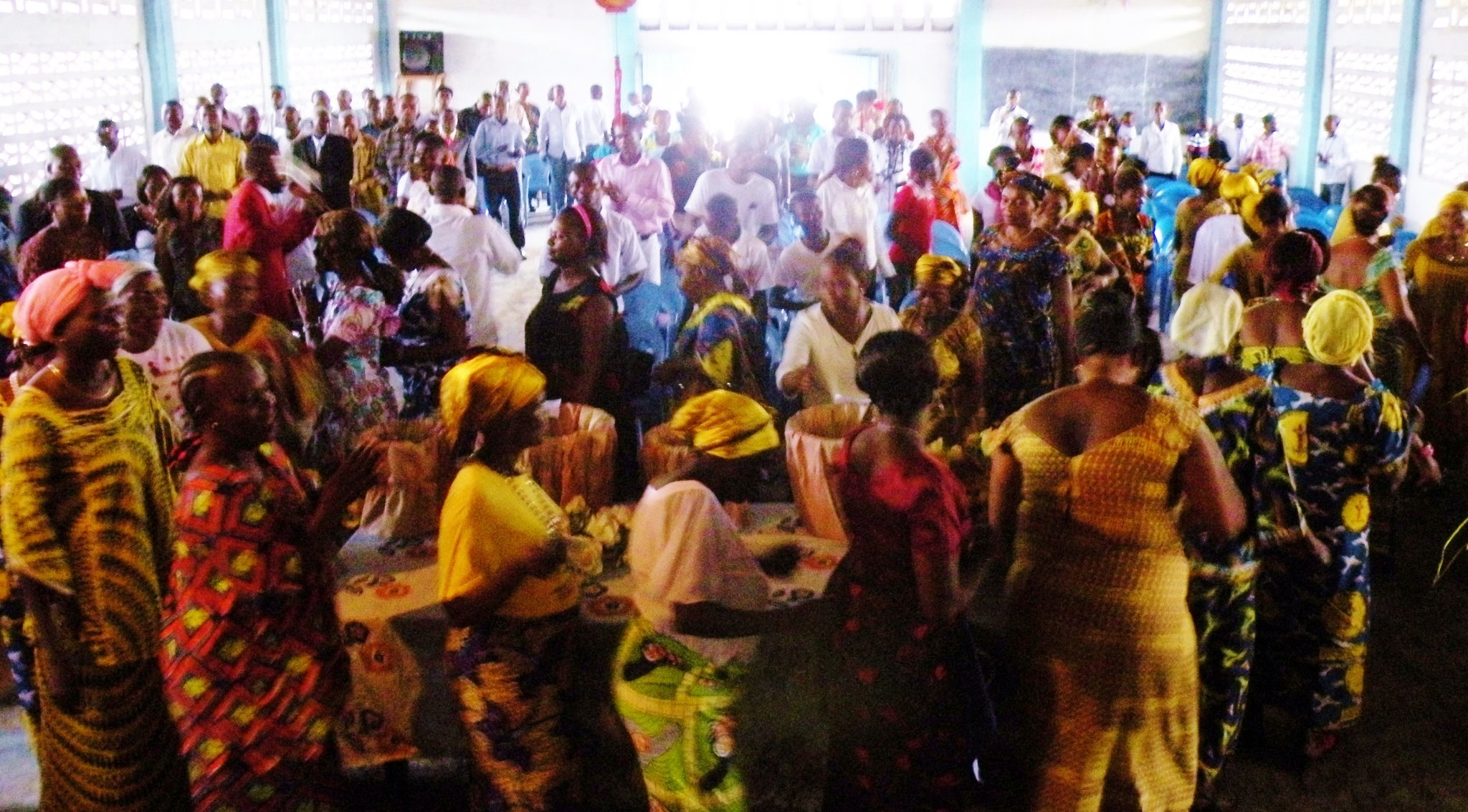
Sometime before my first recent visit, in May 2012, (my first visit since the 1970s) I got the sense that going to Congo would be a sacred journey. I don’t know why, exactly. My involvement with the Congo Cloth Connection–which was all about beauty–had revived my dormant crazy Africa love. But this was about more than sentiment, more than a romanticized attachment to things Congolese. I decided to prepare for that trip as if it would be a pilgrimage.

Before I went I prepared with prayer, offerings, and ceremony. When I was in Congo I tried to see every event and circumstance with the eyes of the heart. I considered the possibility that every step I took over garbage-strewn streets was on sacred ground, that every traffic jam was a trial on the journey to a sacred destination. And that was as close to the truth of that trip as any story I can tell about it. God was everywhere! I thought often of labyrinths. At the center of the labyrinth of rutted streets was the outdoor funeral; the roofless church building bursting with praise; the dinner served in the hot, crowded home; the store stacked with gorgeous cloth.
kalonda exteriorjs

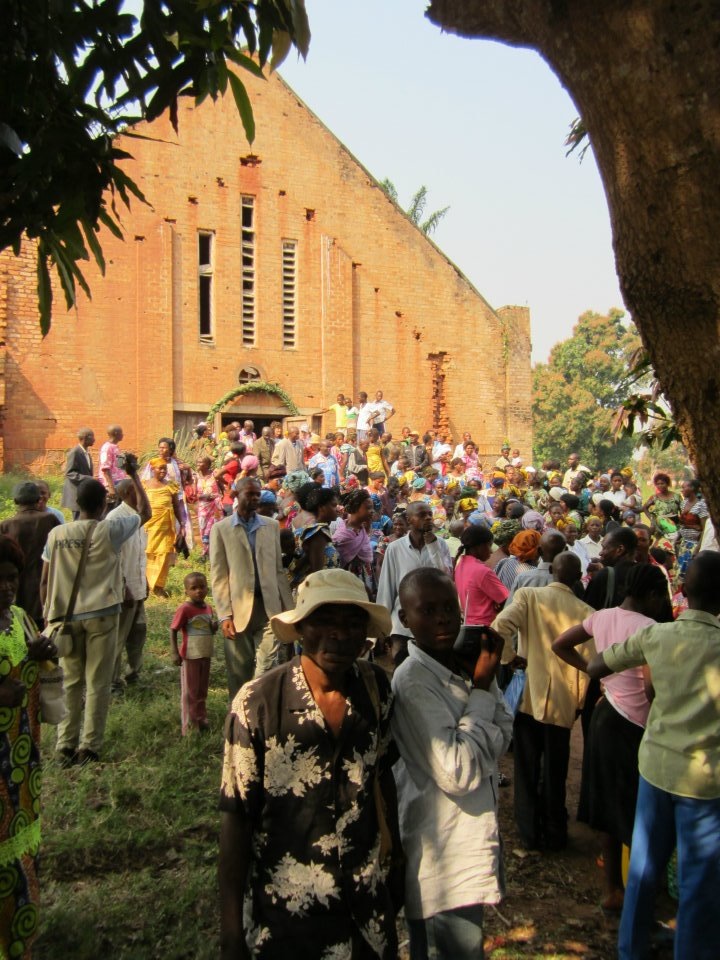
Because of that experience the second trip, just two months later, became even more obviously a pilgrimage. It was a celebration of the centennial of the Mennonite Church in Congo, a visit to places and people important to that history. Like any true pilgrimage, that trip was full of trials for me–an injury to my knee, too many encounters with noisy, welcoming crowds–but these did not diminish the sacredness of the experience. On that trip the holy of holies for me was the unique music of Congolese church choirs.

So I am now setting out on a third pilgrimage, this one with three themes. The first is choirs. They are calling me back and I want to bring my husband into that experience. Vic is going with me and we are going to listen to and record/video as many choirs as possible. We are going to great lengths (upriver in a rubber raft with a diamond trader) to record the best choir I heard last July, a choir whose music seemed to come directly from the spirit world.

The second is to celebrate the ordination of the first women as pastors in the Mennonite Church of Congo. That is what brings our fellow travelers with us. We all come to celebrate with these women and the church that has taken this step. I have writing assignments around that and, in fact, I am writing about all of this. The two ordination services we will attend will be splendid, full of music and spirit. They will bring the Mennonite community together and we will be among friends.

Finally, Vic and I are making a personal pilgrimage to Lubumbashi, the city where we lived for two years back in the 1970s. Is the hospital where our daughter was born still standing? Have the shattered windows in the university administration building been repaired and does the chemistry lab have running water? Will the Park Hotel still host us in shabby grandeur? Is the French Consulate swimming pool, where Joanna took her first steps, still open? We will try to find our airy little house on Ave. des Mandariniers, surrounded by jacarandas, poinsettias, and hibiscus, but who knows.

All of this feels holy. Pilgrimages include trials, like squat toilets and iffy lodging, and the trials begin now as I deal with logistics, not my favorite thing to do at all. The rewards lie ahead.

choir

Orange and yellow guinea fowl

with Jeanne, fellow cloth connector

with Jeanne, fellow cloth connector

I spent last week surrounded by African cloth. It was in an over-air conditioned exhibit hall in Phoenix, where the outside temperatures rose to 118 during the week. One airline worker said when some of our friends arrived, “Welcome to hell.”

Our cloth booth was a heavenly place in what I wouldn’t call hell exactly but it was a sterile, artificial environment. It didn’t help that I was working the booth 11 am to 11 pm with little chance for solitude and no inviting nature nearby. Now that I am home I’m basking on my front porch, even though it is dark and humid and pouring rain. At least it’s natural.

I’m thinking of turning one of those lengths of bright cloth into a tablecloth and napkins for my porch table. It took five days of looking at the hundreds of fabric lengths in our display till I settled on that piece as the one I wanted to take home. Orange and yellow plaid with guinea fowl.cloth

Maybe it was because my eyes got used to all the colors, since I was exposed to them for so long, and so I gradually came to love the brightest one I saw.

Maybe it was because I thought of how my granddaughter would enjoy the strange chickens on the design.

Maybe it was because I thought of how that tablecloth would brighten up my screened-in porch, which is all browns and grays and surrounded by green, green, green.

This is all true but really it was because no one else wanted it. We had two 6-yard lengths of this design and they were among the few pieces that didn’t move at the Mennonite Church USA convention last week. No quilters wanted a yard of it, no shirt makers or skirt makers or pillow coverers were tempted. This design goes with nothing. It is what it is, bold and bright.

This is how Congolese women dress, power to them in their confident beauty. They would consider it a waste to use it on a table. It needs to strut its stuff in the marketplace. But still, it finds its way to my house and that is something.

Our project, the Congo Cloth Connection, is about influencing each other, finding common ground, forming relationships between Mennonites in Congo and the USA. It is secondarily about raising money for projects in Congo. With the donations we’re collecting for this cloth we’re funding scholarships for Congolese Mennonite women studying for the ministry. This is a new thing–the church only recently approved the ordination of women–and it’s the feminist issue among our friends there.

This fall I will carry scholarship money for four women in Kalonda, DR Congo, age 21 to 62, who are fulfilling their dream of becoming pastors. While I dress my table in their cloth, they study the Anabaptist theology of our mutual heritage.

We’re not selling the cloth (hand-carried in suitcases by our traveling friends) online. This is not a long-term, big $ project. It’s just a way of making connections of beauty and joy between a few churches in the Midwest and our growing network of friends in DRC.

Orange and yellow guinea fowl crossing the continents, coming home to roost.

porch


A mystic in trouble

Why do I even do this? I ask myself several times a day when I am tending Congo matters. How did I get myself into this difficult situation, who am I to be doing this? But the question is always rhetorical, not because I know the answer to it but because I know I will keep doing whatever it is I am doing, even though it is difficult. The situation I’ve gotten myself into is exactly where I want/need to be, even though it isn’t always pleasant.

But I try to address the question head-on every now and then because motives and reasons can sneak around and bite you in the back if you don’t keep an eye on them. They do keep changing, even if your actions remain outwardly the same. If you aren’t aware of the changes you can start lying to yourself, unwittingly, and that is never good. The better side of this is that as time goes on motives may become clearer, and it is always rewarding, always a good thing, to understand yourself better, to understand what is happening to you that causes you to behave in the way you do.

The situation I am referring to is that I continue to take a very active interest in a particular Christian community in perhaps the poorest country in the world, a country ridden by impossible conflicts, though those conflicts are largely outside the territory of this community. So, it’s not because I think I can do anything about the chaos and suffering in eastern Congo. It’s not, in fact, because I think I can do anything about any kind of suffering in Congo, including the suffering of poverty. Relieving suffering is not my motivating force, not what calls me, although it may be a blessed side effect of some things I do.

I do hope not to create more suffering for others though that, too, can be a side effect. So maybe I will create suffering, unpleasant as that may be for me to witness, because suffering is necessary for growth. I’m finding this in my own case and who am I to say growth should be easy for other people? I am suffering a little right now, asking myself, why do I even do this? Because it isn’t easy; it is, in fact, sometimes agonizing.

Early on what got me into the Congo thing, which has intensified over the last year and a half, was a combination of nostalgia (for a previous experience in the distant past), love of beauty (Congo Cloth), and serendipity: the unfolding of a series of circumstances that came together in quick succession, making certain actions and developments seem right.

Then, quickly, it came to be about relationships. When you start relating to a new group of friends, become involved in a new network, certain things become possible and certain things are asked of you and you respond. Relationships require communication and lead, inevitably, to responsibility but they are also sustaining. So I can say that I need this new group of friends; that they are becoming like another very extended family for me, creating warmth and home and familiarity in ways I could not have imagined two years ago.

But none of this gets at the big, mysterious Why. Why Congo, why me, why now?

I could put it down to feeling called. It is that for sure, but the answer does not satisfy me so why should it satisfy you? I have done a lot in my life without the (maybe sometimes dangerous) certainty that goes with feeling called, and so I don’t think a sense of call is necessary to compel me to do odd things like work for nuclear disarmament or wrack my brains over environmental policy. But I have done these things out of a similar combination of circumstance, attraction, relationship, responsibility, and mystery. And with the similar frustrations and agony that come with doing anything difficult (even apparently impossible).

The common thread here seems to be, “difficult things.” Why do I repeatedly go for the difficult, the impossible? It seems to be in my DNA, but it is also a result of how I live, that is, by such airy methods as prayer and paying attention to dreams, and in an everlasting quest for wisdom (knowing I will never have enough of it to make sense of myself, let alone the world). These difficult situations are the practical results, for me, of living as a mystic.

Living as a mystic gets me into difficulties. I get focused on something and can’t turn away. Prayer and dreams trick me into taking bold steps that make no logical sense. But living as a mystic also gets me through difficulties. It does not, believe me, keep me from making mistakes. The mistakes, however, usually get transformed into wisdom and learning, and correcting them requires more bold moves in a good direction. Away from fear, toward love. That movement, propelled by spiritual power, is what it is all about.

Mystics, unite! The world needs us, getting down and dirty, getting into trouble.

Crosscultural “telephone”

You know that old party game where you pass a phrase around a circle in whispers? It always morphs into something totally ridiculous. We called that game “telephone.”

This happens all the time when you are trying to communicate with multiple people, mostly by email, across cultural and national boundaries. I’ve been involved in one of those snafus today.

Saturday evening at a concert intermission a friend I’ll call Pete, who goes to my church and makes frequent trips to Congo, told me he’d just gotten an email from a mutual friend I’ll call Pierre in Kinshasa, asking for an invitation to come to the US around the end of June to mid-July. (To get a US visa, Congolese visitors need a letter of invitation that states the purpose of the visit and itinerary and basically guarantees the traveler will go back home instead of trying to stay—God forbid—in our wonderful, exclusive country.)

Pete said he didn’t know why Pierre was asking him for this invitation and, besides, he wouldn’t be around at that time to put up any visitors. He said Pierre was planning to come with someone else. Did I know what this was about?

It so happens that weeks ago I told Pierre I couldn’t give him an invitation for a trip. The dates were approximately the same. The purpose of that trip was partly to visit our church and it simply didn’t work for the church, for me, or for others concerned. It also would have entailed some financial support. I said we would work it out for a later date.

This request looked like he wanted to come anyhow, didn’t need the financial assistance he said he needed, and was doing an endrun around my refusal.

Meanwhile, I’d scheduled both travel and other guests for that period. Not being able to host him at all would be a big faux pas, considering how Congolese bend over backward to show hospitality.

I was absolutely ready to believe the story in my mind. I silently fumed for a while about Congolese deviousness and manipulations and pushiness before composing what I believe was a polite letter this morning telling Pierre what Pete had told me and asking about his plans for this trip.

I soon had an answer back from Pierre.

It turns out that this trip wasn’t his idea; that one of his business friends wanted to come shopping for a Mack truck and would pay Pierre’s way to accompany him, because the friend has never been to the US and Pierre knows his way around.

It turns out that Pierre had talked to Pete about this when Pete was in Kinshasa six weeks ago. Apparently Pete forgot that conversation. I don’t know what Pierre said in the email but perhaps the essential details were there. Even I don’t always read email carefully, and I live by email.

It turns out Pierre and friend wouldn’t even come to this area and he might not come at all.

Well, another potential international disaster evaporates. Another reminder of how hard it is to build crosscultural trust because we jump to conclusions, misread, misspeak, misunderstand.

Is it worth the effort? Absolutely.


Goals, objectives, and God

In my professional life I learned to sling the jargon of strategic planning. I know the difference between goals and objectives. And I know how to write reports and proposals that make it sound like the life of an organization or a person can be arranged in a logical hierarchy: the overarching mission, then the goal, then the objectives that serve as milestones toward the goal.

Generally, however, I don’t believe it. I think life is much more organic, less predictable, and both more difficult and fun than that. Life is not logical. Life happens in the unpredicted cracks in the sidewalk of your consciousness. This is true for organizations as well as people.

But recently my life has surprised me by sorting itself into goals and objectives. True, it has done this in an upside-down way. The objectives have come first and the goal has emerged more slowly, but now that the goal has emerged the objectives make sense, they hang together. They clearly lead to the goal and are necessary if I am to accomplish it.

The goal is to write a book about Congo through the lens of the joy of worship music–écrire un livre sur Congo à travers le prisme de la joie de la musique d’adoration (I am running everything through a mental or Google translator these days).

I was not able to articulate this goal until very recently, although versions of it popped up now and then over the past year. I have only sensed the need for a Next Big Thing, a major writing project, without being able to define it.

Instead, certain objectives presented themselves one by one. I have been acting on these objectives without knowing the goal, in fact, because I didn’t know the goal. I didn’t know what the Next Big Thing was but I could do each of these smaller things that presented themselves and captured my attention. (I have blogged about all of these but won’t pepper this post with links.)

1. Learn. I edited a book about the Congo Mennonite Church in late 2011 to early 2012 and in the process learned the church’s fascinating history, something I hadn’t learned in my three years in Congo back in the seventies.

2. Go. But my involvement with Congo Cloth Connection predated that, and I went to Congo last May with that project. I had a great time and my love of Congo Cloth expanded to include Congolese church music.

3. Network. Following up on both of these things, I decided to go to Congo again for the centennial celebration in July. Thus in the space of a few months I was drawn into a network of warm relationships with Congolese Mennonites.

4. Deepen. Last fall I began working with a spiritual director and established a meditation practice.

5. Publish. I decided I couldn’t move on to a Next Big Thing until I decided what to do with a manuscript that had been languishing for several years in the “what am I going to do with this” pile. In the course of a few months I revised and published it as The Dream Matrix.

6. Energize. The July Congo trip had worn me out. I decided I needed to lose weight and adopt a diet and fitness regime for maximum energy. I have done this over the course of the past eight months: Weight Watchers, gluten-free, mostly vegan, 3 miles a day. Two-tenths of a pound to go as of today to reach my goal (objective!) weight.

7. Flow. My daughter-in-law gave me a Christmas gift prompt that led me to adopt the word “flow” as my theme this year, to keep all these streams flowing and moving in the same direction. It worked when I needed it most, in the first quarter of this year.

8. Dream. Publishing The Dream Matrix prompted me to lead a dream class in church and pay attention once again to my own dreams. Some of this sequence has emerged through those dreams.

9. Partner. The Congo relationships have continued to blossom as I work on a partnership between my church and a congregation in Kinshasa, host visitors, and address cross-cultural challenges.

10. Write. Writing this blog has catalyzed each of these developments because I write my life—I write about it and I write my life into being if that makes sense. But in addition, just as I was beginning to dare to articulate my goal, an opportunity came up to write—to travel to Congo in September and October of this year to report on the ordination of the first women in the last branch of the Congo Mennonite Church that had been holding out on ordaining women. Choirs will be there. I know some of these women. My husband and I are beginning to plan our trip.

All of these objectives just happen to lead toward this newly articulated goal. This, my friends, is how I experience God. God is in the gift of the goal, God is in the timing of each of these so-called objectives. Maybe God is the great Strategic Planner.

The way of Invisible Woman

I started reading Claire Messud’s The Woman Upstairs last night. It is haunting me, affecting my dreams, because the voice in the early chapters is one I hear in my head all the time.

An image from my dreams of last night: Three pieces of fried chicken–two legs and a breast. My younger brother and husband are there. My brother takes the two legs, my husband, the breast. I worry about whether it is enough for them.

When I wake up I realize I didn’t even think of taking one of the pieces for myself.

The voice of the novel is like the part of myself I think of as Invisible Woman, the one who works behind the scenes, serving others and perhaps never getting around to her own art. It is the voice of both the main character in the novel, an elementary school teacher who is really an artist, and her late mother.

We are haunted by what we have not done with our lives because there is always another mess to clean up, another demand waiting to be met, someone else’s work to help with, and we are good girls. We let these things take priority. It is not in our nature to put our own work first, it simply isn’t. And sometimes this makes us really angry, not at the world but at ourselves.

However, recognizing this aspect of myself doesn’t send me into a tailspin any more. Invisible Woman has her own ways of doing things and sometimes it works out well, in a way that serves my purposes as well as other people’s. Here is a story about that.

Recently I agreed to host a dinner party for two Congolese businessmen who were visiting church agencies in the area to learn about church finances. I agreed because I believe in showing hospitality—an Invisible Woman trait. I agreed because it seemed like a simple thing, hosting a potluck for an unknown number of guests. However, potlucks require a critical mass of guests and dishes and it became apparent, in the planning, that this one wouldn’t reach that number, so I just went ahead and cooked an entire meal. This is usually no big deal for me but I was tired that day and would have preferred sitting in and watching a movie rather than pulling out my outgoing, French-speaking hostess self.

These events usually turn out to be worth the effort and this one did, too. It took a while for the Congolese men to warm up but the other Americans carried the conversation until they did and then, toward the end of the meal, I mentioned our desire—my desire, which I have persuaded my husband to share—to visit Congolese Mennonite churches sometime in the next year and listen to as many choirs as possible, to do what I’m calling choir tourism. And to write about this and maybe put together some videos.

The Congolese businessmen lit up and became downright chatty. And this is when Rod, the agency director who was squiring the Congolese about, pointed out that the first women were going to be ordained in a major branch of the Congolese Mennonite Church in September and October of this year and would I like to go and write about that?

Well I most certainly would. The ordinations, I know, will be occasion for grand celebrations, with lots of choirs joining in. It is the kind of event I was looking for.

I didn’t tell Rod that I would rather not write on assignment for church publications, that I had been set on writing entirely for my own purposes (I’m not saying “book” yet even to myself). I didn’t tell him that this next trip to Congo was to be a kind of self-test of my seriousness as a writer, a test of whether I had enough confidence in my own work to spend tons of money, uproot us for a month, and plan an arduous and complicated journey just so I could write.

I didn’t say any of this because the opportunity seemed just too serendipitous. Of course I can do some articles. The assignment will, in fact, force me to be serious about interviewing and making notes. I won’t get away with the kind of vague intention I harbored last July when I concluded that I simply wasn’t up to writing about Congo. I didn’t have the chutzpah to do interviews, the energy to write down all my observations, yada yada. No excuses this time.

Still, I managed to write quite a bit on that trip, and I had written even more on my first trip, when I had my laptop rather than the iPad with the onscreen keyboard (which I never got used to and, believe me, writing technology makes a huge difference). As for the energy I need to work hard, I’ve lost 20 pounds since last July. I am renewed, revived.

I can’t believe I shouldn’t take this opportunity to do something for someone else and use it as a way to support my own art. The money, the discipline, the deadlines will all help. I may use some of the money to hire my friend Charlie Malembe, an ambitious young Mennonite journalist in Kinshasa, to help with the interviews. She doesn’t yet know how to write for a US audience but she’s a great interviewer. My stringer. I will happily share a byline with her.

This is the way of Invisible Woman. I don’t have to do everything by myself, for myself. I am a team player. I seize opportunities that provide the momentum I can’t quite generate myself.

And, of course, the tiny bit of effort I expended to feed those two strangers (chicken grilled, not fried) will no doubt be repaid tenfold on this next trip. The Congolese are magnificent hosts.


This organic life

house

I need to put the hummingbird feeder out. The birds are due any day now or perhaps they’re already here and snubbing us because I haven’t put the feeder out.

This thought arises suddenly and makes me think of the miscellany of my to-do list. It is rich and shapeless, everything wanting to be done at once.

Sitting on the porch, watching the colorful birds of spring (indigo buntings, siren-yellow finches, rose-breasted grosbeaks) and wood ducks looking for a nesting place in our woods—this is high on my spring to-do list. Alas there is no water on our property so it is not prime wood duck real estate but they come looking every year because we have great tree holes. We also have a hawk nest this year so beware, little birdies.

Wood nettle shoots are at their prime. I must go out and snip another bagful. I took a mess of nettles to a church potluck yesterday (steamed briefly, tossed with olive oil, garnished with violets). Every year I introduce more people to this spring delicacy. It takes some faith to bite down on plants that will sting like crazy if you grab them raw but immersion in a hot bath makes them sweet and safe. I don’t like the more common ditch nettles, however. See my post last year on this.

Having dreams is on my weekly agenda. The only preparation I can make for the communal dreaming class I am conducting for nine weeks at church is to have dreams myself, and I don’t have a lot of control over that. As it turns out, I often don’t even bring up my own dreams because other people’s dreams fill the hour. The dreams are rich and amazing and reveal their meanings as we talk about them. I discover again that I am quite good at helping people interpret their dreams. Some shared images appear in our dreams. Speculating about what this means.

I am praying daily for friends of a friend who are being held captive in a foreign land. This requires making time and place for the prayer to be received (that is, knowing what I should pray) and offered. It is not a prayer to be breathed at my desk although I do that, too. I usually go out with the trees, to get their help.

Helper trees

Helper trees

I am thinking through and consulting others about aspects of a partnership between my congregation and a congregation in Kinshasa that I know well from two visits there last year. Especially, how do you address or get around the vast economic differences without opening great cans of worms? I write up a proposal and send it off to a few people for vetting. This is difficult and necessary headwork in a project that is, for the most part, a work of joy and spiritual enrichment.

I am deciding what to do about biking. What would it feel like to give it up? Why did I have a sudden surge of jealousy when Vic asked how I would feel if he decided to buy a new bike (and I didn’t)? On the other hand, why am I enthusiastic about the idea of funding scholarships for Congolese students instead of buying a new bike? Sorting out my own feelings. Sorting out the state of my body as well as my spirit.

I just arranged for an energy healing session to address my recurrent UTIs, which have now become resistant to most antibiotics. This is related to the biking question because I can’t afford to keep having UTIs and biking seems to instigate them sometimes.

And it relates, in turn, to dreams, because I had a dream in which energy healing was being done on an Atlantic beach. I was to take my turn at healing and being healed before even putting a foot in the water. The ocean represents Soul waters for me. Also, the Atlantic links us to Africa, so perhaps it is a reference to my next trip to Congo.

That trip is taking shape and moving up on the to-do list. I may post about that soon.

Maybe my to-do list is not shapeless so much as organic, one thing merging into another and branching into yet others.

Intensive living

I have a habit of posting really trivial stuff just as horrible news is breaking. Last Monday I wrote about what makes people “like” something I’ve written and then I saw the news about the Boston Marathon bombings. So there it was, the trivia of my daily preoccupations set against something really important.

This morning I was thinking of writing something but first I caught up on the news. Boston is shut down as one of the alleged killers is being pursued. A Texas fertilizer plant turns into an even bigger killer. Chicago is flooded. The Senate chickens out on gun control.

I decided to postpone writing about the Zen of sewing. Maybe later, when the news has calmed down (when will that ever happen).

When I was traveling in Congo last year I would use occasional Internet access to catch up on Facebook and other news and I would think how trivial everything happening in the USA seemed—even disasters—in the context of the struggle for survival that engaged every Congolese I knew.

It’s not that they were leading tragic lives, but they were living more intensely. Everything about life in Congo seemed more intense: pain, struggle, joy, gratitude, love, conflict, beauty, ugliness. Being in the presence of this intensity was both exhausting and exhilarating. I miss it a little now. Perhaps my hesitance to write about my life in the face of Really Big News is really a regret at the loss of intensity.

We feel empathy with those in the news, those who are really suffering. But there is something artificial about the way our national attention swings from one city to another, one distant or not-so-distant tragedy to another, our empathy drawn out over degrees of separation that only emphasize our individual powerlessness to console, heal, prevent, protect.

Living intensely is the opposite of living at the remove of distance, the remove of the news. You can only live your own life intensely, not other people’s lives.

I think of this in relation to Newtown. We have been moved by that tragedy but not enough to enact decent gun laws because too many powerful interests, deep national divisions stand in the way. Too many degrees of separation between our empathy and real change. The “timing” isn’t right; the politicians can’t manage both immigration reform and gun control in the same session.

I’m not saying we are entirely powerless. We can throw the bastards out. But that takes time, organization, determination, working together. It takes intensity, which means bringing it into the days of your own life. Like maybe working in a political campaign.

Meanwhile, I’m practicing intensive living. Some days that just means doing a sewing project and learning something from it. Maybe I’ll write about it, maybe I won’t.

My Next Big Thing

The truth is, I’ve hit a snag. Flow stopped, motivation gone, I am at a loss for what to do next. I’m retired, I can do what I want, but that is easier said than done. What do I want?

On this warmer but still gray afternoon in early April, with only a hint of green and hepatica (yay, hepatica!)  in the forest leaf cover, I feel like I have started a thought and lost it, mid-sentence. What were all these plans I had as recently as January 1? I had what I thought was a year’s worth of desires lined up. All I had to do was follow through.

hepatica

Yay, hepatica!

Maybe it wasn’t a year’s worth; maybe only three months’ worth.

No, that’s not quite right. Some of those plans are accomplished, ta-da, done! Or almost. I work really fast when I put my mind to it. Others are not yet fully executed. I have done the easy parts and many of the hard parts but now there are some really hard parts left and I am running out of steam.

In the accomplished column is the publication of a book that I thought I would never finish writing and revising, let alone publish. Ta-da, done! I did this much faster than I thought possible and had fun mastering self-publishing, which has come a long way in the last few years.

In the nearly accomplished category: weight loss. I thought I couldn’t do it and then I did it. Ta-da, goal in sight!

Yet to do: get back to biking. But I have made progress by finding the guy who will help me get on the right bike. I will visit that shop outside Detroit again in the next month. Meanwhile, I will start to toughen my butt on my old bike as soon as the conditions are right. (I require temps in the 50s or above but not too hot, no rain, not too much wind. Today is a tiny bit rainy and besides I already got my exercise at the Y.)

However, what is really bothering me on this too-open afternoon, making me feel like a cowardly, unmotivated lazybones, is that I haven’t yet started my Next Big Writing Project.

But come to think of it, that’s not true. I have started the project but it is not yet at the writing stage.

  • I think I know what it is. I want to write about Mennonites in Congo and the power of music and faith in some of the toughest circumstances on the globe.
  • Since making two trips to Congo last year, I have been working on developing a special relationship between my church here and a congregation in Kinshasa.
  • I have revived the Congo Cloth Connection to create relationships and fund projects for women and children in Congo–we’ll do another big cloth market at the Mennonite Church USA convention in Phoenix in July.
  • And I am starting to think about my next trip to Congo.

I am hung up on this last point, however, the next trip. This will be a trip I do entirely on my own except my husband will go with me this time. But no sponsoring project, no special occasion like a centennial celebration, no fellow travelers. I want to go to visit churches and listen to as many choirs as possible. I want to go to write. This would be a research trip for my Next Big Writing Project.

There is a gap between the desire to do a thing–go to Congo on our own and listen to choirs–and making that happen. It is in this gap that the desire begins to doubt itself. Do I want this badly enough to do everything it takes to make it happen? All the money, logistics, contacts needed to travel in that compelling, outrageous country. Just for me. Just to write.

I need to believe in myself both as a doer and as a writer in order to move off square one. I am writing this as a statement of intention. If you wish, hold me accountable. Cheer me on.

Communal dreaming

Dreamfinal

Coming soon!

I have been working on a memoir very off and on for years. I will soon be ready to put the e-version out in the world though the print version will take more time. I’ll let you know.

It has taken so long because it is a complicated story. It’s called The Dream Matrix: A Memoir of Connection. How do we actually experience mystical connection with other people and with the Divine? This story is about several threads of my own experience with that, especially communal dreaming. This is what I call night dreams that cross boundaries, becoming a conversation with and for a friend or a community, often moving in the realm of divine mystery. The memoir contains many examples of such dreams and the art of interpreting them.

Communal dreaming harks back to stories in the Bible—Joseph, Jacob, Daniel, and many others dreamed for a community and interpreted the divine messages of dreams. And I consider this story part of my personal “Bible story.” It has also spawned sacred stories for other people and several communities, including the church of which I have been a member for more than 30 years and even the environmental policy community.

Every time—every time—I take this story up to try to finish it, it goes into action again, creating new chapters. That is, I start having dreams again and they take on a communal character. On the one hand this confirms the basic truth of the story but on the other, it’s frustrating. The story keeps squirming out of control, declaring that it has no end. Nevertheless, I’ve limited the memoir to two such periods in my life, ten years apart.

This month as I have been working on the book it has happened again.

Church has been a theme of my life in January. My husband and I are saying goodbye to our longtime Chicago church and becoming members of the church we’ve been attending in our new community 100 miles east of Chicago. I am also helping establish ties between this congregation and a congregation in Kinshasa, DR Congo.

That is, I am transferring church membership and pursuing church-to-church relationships. When you put it that way it sounds dry and institutional, and we churchy Christians often speak in such cryptic, neutral language. We even act as if these were decisions of the head, ones that can be worked out in logic and meetings. But the heart speaks in dreams.

One day last week we met with our new pastor to discuss membership. The same evening I attended a meeting about the Congo relationship. That night I had a pair of dreams about two flocks of very large, beautiful birds. One flock looked like sandhill cranes—birds I associate with the Midwest—but they were in Africa. The other flock was a gorgeous variety of flying ostriches—birds associated with Africa—but they were landing at a set of church retreat buildings in the US, bringing astonishing beauty to a rather drab, institutional center.

I welcomed these dreams as transcendent gifts. They confirmed the rightness of my decision to join a new “flock.” They also symbolized the exchange, the relationship of these beautiful flocks from different cultures and continents.  I may tell the dream next Sunday as my faith testimony when I join the church. Who knows? New Bible stories may unfold.