Download silence

It is hard to believe my meditation practice is only 10 days old. Already I can’t do without it. It is a necessary part of my day.

It is not easier and easier to do, however. In fact, it continues to be difficult to empty my mind of everything for more than a few seconds at a time. But the difficulty is also a delight, as Cynthia Bourgeault, author of Centering Prayer and Inner Awakening, suggests, because each act of letting go brings a tiny tingling of the tummy, the opening-out of the solar plexus that signals rightness, ease, harmony. This is a way of knowing that the active mind can block out.

The catch is that if I focus on that reward or any other experience of the meditation—the swirling blues and greens that I eventually see when my eyes are shut and I have sunk to the place of no words; the ease of deep breath; or any other sense of myself—I am already back to nonmeditating mind. In Centering Prayer one must let go of these experiences, too. But the rhythm of experiencing and releasing is a kind of breathing; the knowing and the not-knowing, in and out like waves on the beach.

At the end, indeed, I feel washed, washed up like driftwood with all its rough edges worn away; smooth, easy, able to move through the day with fewer stops and starts and resistances and reactions.

Night is a different story, however. The practice has revved up my dream life, which had been literally dormant for some time. The dreams have not been poetic; they have been scatological. I have dreamed for several nights running about excrement. Maybe that, too, is about cleansing. It may also be, as the Jungians would suggest, about creativity. Shit is the human being’s first and most basic product. Whatever it signifies, I accept the Dreamgiver’s sense of humor.

Here is something I learned after my first few sessions of Centering Prayer: you need a timer. No sense guessing when 20 minutes might be up or depending on how you feel to decide when to stop. That invites normal-mind activity, which is what you want to get away from

I debated setting the microwave timer but that didn’t seem very spiritual. I thought, I need something that sounds like chimes or a Tibetan bowl. Surely some spiritual marketer has thought of this?
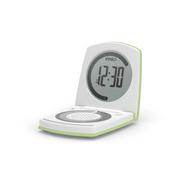
Enso Asari Meditation Timer/Travel Alarm, $59

Well of course they have. I went online and searched “meditation timer.” You can buy timers with chimes, gongs, and singing-bowl tones. You can spend a lot of money on timers shaped like pyramids, circles, spirals, and portable alarm clocks. Practical mystic that I am, I was taken with one of the cheaper ones—at $59!—that doubles as a travel clock and alarm. I’d like it in Sage Green, please.

But here is another option. You can go to a couple of sites and download timed silence. This one  gives you a choice of audio files that consist of various lengths of silence. A bell is rung once at the start and three times at the end.

It’s free, as silence should be. Download some now for yourself.
Centering Prayer

I am beginning a regular meditation practice. I have circled around meditation for a long time, like a cat looking for just the right napping position. Now I have settled on something. I should have asked for help before on doing this but perhaps not. The right teacher comes along at the right time.

My way of asking for help on this, not just meditation but spiritual practice in general, was to sign on with a spiritual director. Spiritual direction, too, is something I’ve considered before, but I wasn’t ready for it. I don’t know why. I wasn’t ready and now suddenly I am ready, with urgency and hunger. In our first session, my spiritual director, proving herself to be the right teacher at the right time, directed me to a meditation practice and a book that describes it. I sped through the book in a few sittings. Sometimes the right book comes along, like the right teacher. This week the book has also been my teacher.

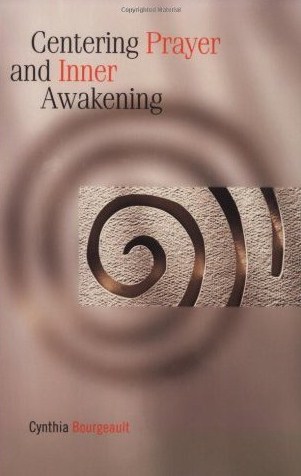
The book is Centering Prayer and Inner Awakening by Cynthia Bourgeault (Cowley 2004). There is a whole Centering Prayer movement but I had only a vague notion of what Centering Prayer might be (wrong, it turned out).

I find that I already know much of this. I’ve learned it on my own, from other sources and my own experience. At the same time I have so much to learn and unlearn that it’s funny. I’ve tried to write about a lot of stuff that I have only vaguely understood and here I find Bourgeault calmly explaining everything and putting it together. The right book at the right time makes sense of something you recognize but haven’t fully understood.

Here is what I have experienced before.

  1. There are different kinds of meditation but the only kind I have been drawn to has been a quest for the state of emptiness, a kind of dreamy state of not holding on to thoughts and feelings.
  2. In dealing with psychological pain, anger, and fears—as well as the vicissitudes of life—I have experienced the profound power of letting go.
  3. I have noticed a feeling in my body, right around the solar plexus, that signals that somehow I am on the right track, whether it is in meditation or my daily life.
  4. I’m regrounding in Christianity and increasingly relating my spirituality to Jesus as well as the Christian community.

With these four kinds of experiences as background, I am taking to Centering Prayer like a duck to water because it puts them all together. The method is simple: 20 minutes of clearing your mind and opening to the Divine. You use a word to gently bring yourself back to center every time your attention gets hooked on a thought or emotion. It’s an exercise in repeatedly letting go.

Simple but not easy, but I won’t explain how or why just yet. I have, after all, done it (under that name) only half a dozen times! And really, Bourgeault is the very readable, scholarly authority.

If you are not familiar with Centering Prayer you may suspect, as I did, that it is called prayer instead of meditation so Christians will think it is ok, not borrowed from some other tradition. I don’t mind such borrowing at all but Bourgeault makes a good case that this particular form of meditation embodies the spirit of Jesus’s instructions on the self-emptying life, of being in God as God is in us. The theology is intriguing, a theology of the heart, not the head. That is, you don’t have to “believe” in Jesus or a “Christian God” in order to set out on this path. Just like you don’t have to be a Buddhist to practice Zen meditation. You just set out and see where Spirit takes you.

I may report now and then on what happens in my life as a result of this practice although—of course!—the practice is not oriented to results. Results are just another thing that you get to release.

Still. May I hope for transformation?

Archives for this blog  February 2011–September 2012 are located here.