Impatience

IMG_0869

I was impatient for spring and then this happens. But isn’t it pretty?

Impatience is creeping into my weight-loss campaign, too. I have four pounds to go. This may not sound like much but it might take two months to get there.

The focus of my impatience is not my diet. I feel like I could keep eating this way indefinitely. Rather, it is about clothes. My wearable wardrobe is shrinking with my body: three pairs of pants, none of them dressy, and a few of my latest sweaters. The rest is baggy. I suppose it wouldn’t hurt to buy some new clothes but that would defeat several of my intentions.

The first was not to buy anything new until I reached my goal weight. I have had the experience of buying things that I thought would fit after I lost another pound or two–and then I didn’t lose the weight. This time, no wishful shopping.

The other intention was not to make this weight loss about appearance. It wasn’t at first. It was about health in the long term and energy in the immediate, as an indicator of health and vitality. And it is working. My energy is up. In a week I walk 10 to 15 miles and do several hours of yoga and other exercises. I sleep well and feel great.

By now, however, I am getting used to this new vitality. Ho-hum. So what else can this new body do? The next thing is fitting it into some new clothes. I am impatient to get to this next thing.

Impatience is unkind. Impatience lives in the future and dismisses the present. Impatience is in a hurry. Impatience is ungrateful. Impatience sometimes says what the heck and sometimes tries to muscle through.

It is not impatience that has got me thus far on this matter or on any other. Rather, I have come to a profound respect for the rhythms and pace of my own body and spirit. I know both the joy of discipline and the limits of willpower. I have come to depend less on treating myself to special rewards and more on recognizing the rewards that are already there. The thing I know to do is to keep focused on the present.

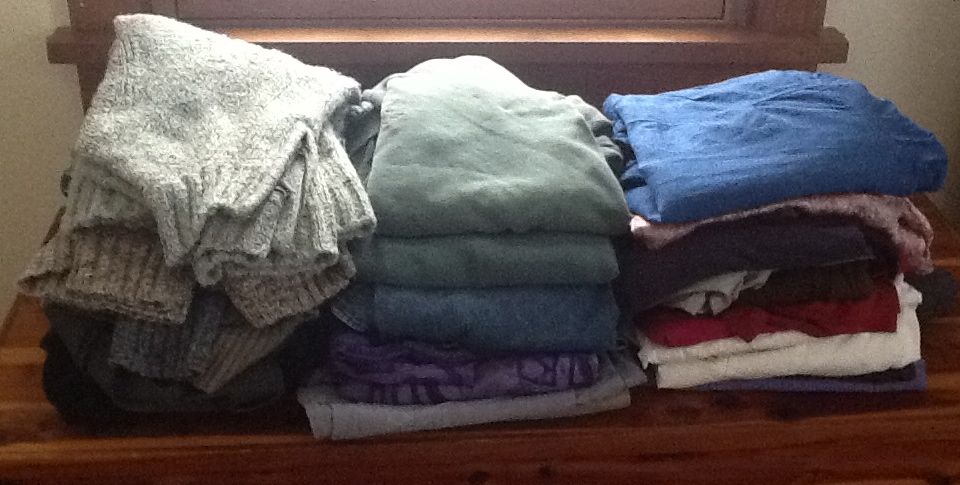
A snowy day is no good for shopping anyhow. But it is good for purging closets. Here are my baggy clothes, ready to bag up for Goodwill. Bye-bye XL! My closet is ready for those new clothes and I am ready for spring. All in good time.

IMG_0872


Getting back on the bike

IMG_0810

My neglected Bianchi

Last year after I suffered a pulmonary embolism I got scared and fat.

Or you could say I lost confidence in my body and one result was that I gained weight.

Ironically, my lungs were found to be riddled with blood clots just weeks after I had achieved a major (for me) athletic goal: I had trained for months and then biked 100 miles one chilly, rainy September day. Actually 106.3 miles.

The health crisis had nothing to do with biking but it knocked the wind out of my sails. I had been all set to buy a new bike in the spring of 2012 and get even more serious about cycling. But all that conditioning—which certainly helped me through the crisis—began leaking away in the 8 days I spent in the hospital at the end of 2011. My energy was at a low ebb by this time last year.

On top of that I was put on blood thinners for the rest of my life because I have a genetic condition that makes me susceptible to clots, and I began to worry about bleeding. You always take a few spills when you are getting used to a new bike and clipless pedals. What if I were biking alone and fell and got a concussion and bled to death before anybody found me?

I didn’t buy a new bike in 2012, nor did I get on my old one. Not once.

I told myself all kinds of stories to justify not biking. I wasn’t ready for a new bike. It was a rainy, weird-weather spring, hard to get on the bike for those 5 consecutive days you need at the start of the season to toughen up your butt. The summer was too hot. I made trips to Congo in May and July.

All that was true, but it is also true that I had lost confidence in my body. I lost confidence in my ability to prevent a fall or recover from it. I lost confidence in my strength and energy. I had long since lost confidence in my ability to control my weight. And my body responded to my lowered expectations. I lost strength and energy, gained weight, and moved with less grace.

I believe my recent bout with back pain was partly a result of this loss of confidence in my physical self. My back had become the repository of all my doubts, insecurities, and fears. Even though I had already begun to reverse the weight gain and energy decline, my back was throwing one last spasm of grief and protest against all the vicissitudes of life as a mortal being. It was at its worst in early December, around the anniversary of the pulmonary embolism.

And then it recovered. I am writing this to celebrate my mortal body, now 68 years old. It is leaner, stronger, more energetic than it was a year ago. I am grateful for my physical presence in this world.

My body will take me on adventures this year. Maybe some of them on a bike. Maybe a new one.

Weight loss and violence

The dream I’m going to report is not pretty. But it is instructive on a topic I’ve been thinking about for some time: my split food personality and how it relates to gaining and losing weight.

I have known that rats are in the house but I’d rather not think about them. Then I see one. It is slow and fat so Lalo-cat is able to pounce on it but I can see he isn’t going to kill it. So I stomp on it with my foot and hold it down, looking for something to kill it with. There is rubble around. I try whopping it with a stick but that isn’t going to work. Then I drop chunks of concrete on its head, my foot still holding down the fat body. That doesn’t work well either. But by the end of the dream the rat is looking sorrier and sorrier, maybe dying a slow death.

I was totally baffled by this dream until my spiritual director read it back to me and asked me to think about the rat as myself. Oh yeah. “Slow and fat.” “Fat body.” That’s the Fatty in me, the one I have been calling “Stuffer.” I had really been hoping to do away with Stuffer once and for all. This dream is about my latest effort to lose weight.

Over the years I have learned to know Stuffer quite well. Stuffer lives in my mouth, not in my stomach. Stuffer gets hungry but not the way the stomach gets hungry. She is tuned into my emotions, not my body. She gets hungry for stimulation when she is bored, company when she is lonely, consolation when she is upset, celebration when she is happy, calm when she is stressed, energy when she is tired. Stuffer tends to address all these needs with food (and drink), although most have nothing to do with food.

Certain foods are especially pleasing to Stuffer-in-the-Mouth. Although she enjoys a hit of carrot cake with cream cheese frosting now and then, she is basically a salty-fatty girl, not a sweets craver. Cheese and crackers, chips and dips, KFC—oh my.

Because Stuffer lives in my mouth she tends to ignore the signals of the stomach until too late. Stuffer has a lot of problems with heartburn.

Stuffer is not only hungry in all these ways; she is also afraid of being hungry. She fears not getting enough to eat so she hesitates to share a restaurant meal. At home she always has seconds, on principle. She fears going to bed hungry. She snacks all evening.

After many months or years of this, Stuffer gets slow and fat, like that rat.

And I get fed up, literally.

I put my foot down (ouch).

And I switch into Healthy Eater mode: Calorie- or point-counting. Portion control. Lots of fruit and veggies. Yada yada. We all know the drill.

After a few weeks in full-time Healthy Eater mode I have all but forgotten about Stuffer. Gone are the cravings, gone the evening snacking, gone the heartburn. Healthy Eater is tuned into the whole digestive tract, not just the mouth. Healthy Eater is more afraid of feeling too full than of going to bed hungry. She looks with horror on large plates of foods glopped with cheesy fat. Because of body awareness, Healthy Eater does a pretty good job of separating emotional ups and downs from eating. She eats when she is hungry and is grateful to be satisfied and no more.

And thus, the Stuffer pounds begin to drop away.

What happens, of course, is a shift in body chemistry as well as body awareness. When you wean yourself off of carby-fatty excess you influence that complex set of hormone signals that suggests what you want to eat, how much, and when. Willpower is involved at the beginning but the need for willpower tapers off as the hormones do their thing. And sometimes the shift is sudden, like flipping a switch. That is very cool. This happened for me on that 3-day juice fast that launched this latest weight-loss campaign, which is progressing nicely and gradually as I continue in Healthy Eater mode, with the Weight Watcher point system keeping me honest.

But my dream was showing me something else that I hadn’t realized before. Which is that all of this involves quite a lot of self-loathing. And that includes both personalities.

While I like being Healthy Eater, I don’t much like her. She is a bit of a weenie, self-righteous and judgmental; a foodie know-it-all who can’t understand why anyone would want to eat those plates piled with cheesy fried stuff; a thinning person who feels superior to all the fatties she sees around her.

And I really don’t like Stuffer. I find her disgusting and pathetic. I want to get rid of her. I, in Healthy Eater mode, would like to hold her down and drop things on her head. Like that poor chubby rat.

Whew. The violent aspect of weight loss?

I resolved to try to make Healthy Eater a little kinder. Try a little tenderness with Stuffer, who is, after all, an emotional gal.

This week at a local restaurant Healthy Eater allowed Stuffer a piece of raspberry cream pie after choosing the chicken noodle soup for herself (both agreed that neither was that good). We have stocked up on treats: Hummus to glop on thin crackers. Dove Promises (dark chocolate, 1 point apiece). Mixed nuts (good protein with the salt and fat). Weight Watchers big latte bars. And Stuffer’s favorite, popcorn—nutrient-free but harmless.

Tonight, while the husband is still out of town, dinner will be a judicious, point-controlled assortment of snacks.

My weight-loss mythology

I am losing weight. Yay, hurray! Twelve pounds in eight weeks. In this process I am discovering and deconstructing my own mythology about weight loss.

Myth number 1: The older I get, the harder it is to lose weight.

I am actually losing weight at nearly the same pace that I did in my 40s, on the same program, Weight Watchers (following a short juice fast).

It is true that I gain weight more easily as I age. I could probably put those 12 pounds back on in about two weeks. It is also true that my body is less forgiving of any slacking off. I rebound a bit after every weekend indulgence or day with no exercise. The rebound usually comes 3–4 days later.

Myth number 2: I can take the weight off just by exercising more.

For one thing, my increasing weight depleted my energy so it was becoming a chore to exercise every day. But even when I did, like last year when I was training for a century bike ride, my weight stayed steady. I need to follow the tried and true prescription of less food and more exercise.

The good thing is that as I lose weight I get immediate feedback in the form of increased energy and this makes it possible to exercise more. That energy gain is much more noticeable than it was when I was younger. The sensation of increased energy makes exercise extra rewarding. Yesterday I swam laps for a full hour and felt I could go on forever, at my sedate pace of 30 laps an hour. But lap swim was over at the Y and the kids were jumping in.

Myth number 3: I know how to eat in order to lose weight and maintain weight loss.

I am a good cook and have long followed a fair approximation of the Mediterranean diet: lots of vegetables, fruit, whole grains, a little protein, olive oil, very little dairy, red wine. I did not need to change what I eat; only how much. And I also needed to greatly cut down on the exceptions I had been making to this good diet. I made plenty of exceptions, especially when I ate out.

I am not good at estimating portions or paying attention to when I am full. This is where Weight Watchers comes in. (I do it online; I hate those meetings with testimonials and cheers for every half pound.) It introduces mathematical certainty to portion control and food choice. You can make exceptions to healthy choices but they take your point quota down fast. With a little forethought and calculation you can indulge in anything you want. But it is safer to stay with really healthful food.

I was shocked to discover how much I had been overeating—and, on the positive side, how happily I could survive on much less. Hunger has not been a problem.

I do not want to sound like a commercial for Weight Watchers. I enjoy “tracking” in a peculiar way. This may be a drag for others. I find, as I did years ago, that the program is, if anything, too lenient. I would never lose weight if I ate all my bonus points or exercise points. I have to stay close to the minimum daily allowance. And I may have to track points the rest of my life (sigh) because when I stopped, I regained the weight and more.

There is something more involved in all this, however; something at the intersection of spirit and body. I will explore it in another post.

Breaking 160

Last week, as the nation dipped below the symbolic 8% unemployment threshold, I crossed my own longtime statistical barrier, the 160 line.

My body has repeatedly resisted that 160-pound barrier and it did this time, too. It plateaued for a week in the current weight-loss project before giving in. It is as if going below that line means becoming someone else, and the body and subconscious are telling me to think twice before I go there. 160 is where I was for my two children’s weddings. I carried my infant granddaughter around at 160: it is my grandma weight. I biked a century at 160. 160 and above is my retirement weight, my aging elder weight. I was prepared to let this weight carry me through the rest of my life.

Who will I become as I continue on this apparently successful campaign? Weight loss is less about appearance than it was in the past for me, more about health and energy. I’d gone well above 160 and was feeling it. I realized the time had come to do something about it.

Already I have a lot more energy than I did a month ago. That begs the question, what can I do with all this energy? I can’t just slack off, sit back, and laze through my retirement years. I’m going to have to start acting like a younger person. This is not an unqualified bonus. With energy comes responsibility as well as possibility. The excuses fall away. I can no longer give the evenings over to TV and reading simply because I am tired. I am not so tired any more.

I don’t think the answer is to program more activities into my life. That is the mode of a younger person who isn’t aware of her energy supply—you just feel like doing things and so you do. I am aware that energy is a great gift because I have been without it. I am aware that health is a great gift because I went through my own health crisis a year ago. So I am looking for worthy ways to spend these precious commodities.

My current diet, the Weight Watchers daily point system, is a metaphor for that. You can eat anything you want but if you eat junk you have to sacrifice good food in order to stay within your points quota. The system is rigged toward healthy food. You quickly discover that junk points are far less satisfying than real-food points. Junk points take you way over the quota before they satisfy your appetite and then you feel bad afterward, physically and emotionally. You want to spend those points wisely, on food that tastes good, is good for you, and makes you feel good after you eat it. Faced with a tempting carby-fatty snack you ask yourself, is it worth spending points on that? Maybe it is, for a bite or two, and then you find it isn’t as satisfying as you imagined.

I am considering what to do with a slimmer body, how to spend these bonus energy points. I shall have to behave a little differently, dress a little differently, plan my days and projects more expansively. I am enjoying the changes already happening and looking forward to more. My body is telling me, you won’t be the same.