Streaming

streaming-services

I like to think I am a self-starter but sometimes I get really tired of being totally responsible for myself and my work in the world. So I am a frequently lazy self-starter.

On this last day of January 2013, however, I can say that I have gotten a good start on my self-starting this year. It helped to pick a theme for the year–“flow”–because that is how I operate best. I am not a big-oomph, ta-da! initiator. I prefer to ease into things, one step at a time. And so the flow-synonym I adopted as this month’s subtheme was “streaming,” evoking the e-flow of tiny packets of information through the ether, one after another. (I watched a lot of Netflix streaming movies during the dark January evenings but then I always do.)

One step at a time I have created momentum for several projects that I want to complete or continue this year. You can go to plenty of self-help books and blogs to tell you how to do such things. I do not presume to do that. I only report. Here are the tools that have been most effective for me this month.

My flow journal. I have created spreads and sections devoted to several of these major projects, including publishing a book, generating the next writing project, and weight loss and fitness. I record even the minutest bits of progress on these projects in this journal. It makes me feel good.

The List of Difficult Things. Just thinking about things is no good for me. Unrecorded, ideas and tasks float unanchored in my brain, bumping into each other and morphing into overwhelm. Three A.M. thinking is the worst kind–the helpless body and mind take on the to-do lists in the dark and spang! I am awake but paralyzed and everything seems impossible. Because it is, just then.

My antidote to overwhelm is to make a list–at a rational, waking time–of specific tasks that seem somewhat difficult, things that will require some effort, some self-starting. I am generous with what I include on the List of Difficult Things. For example, I hate making phone calls so phoning always goes there, even for overdue chats with friends. (On the other hand I love to be called. Please phone me!)

I then promise myself to tackle one Difficult Thing a day. However, just making the list often makes some of the things on it far less difficult. Yesterday I breezed through two items on the list.

The truth is, the Difficult Things are often not really difficult. Sometimes they are things that seem hard because I haven’t done them before, like formatting a manuscript for e-publishing. When you get right down to it, the task is challenging but not impossible. But often it is amorphous 3 A.M. thinking, conflating everything, that blows things out of proportion. Writing the hard stuff down in the light of day keeps the tasks and ideas discreet and helps me line them up in a sequence. It gets them streaming.

Low-hanging fruit. That sequence for me usually starts with the easiest things. I pick low-hanging fruit. Sometimes I never get farther up the tree, because when I pick the low fruit the higher stuff comes within grasp. Enough of that metaphor; an example: I started by publishing the e-version of my book and now I am working on the print version and it doesn’t seem hard at all.

(Just . . . I could sometimes kill Word and all its little hidden helpers that mess with things. You do not want to know how hard it is to make a linked Table of Contents when Word tucks in default bookmarks that spoil everything. And does it again after you take them out. It has to do with using a Heading style. See, you do not want to know that, either.)

And as I said at the beginning, one thing at a time. I am often a Big Picture thinker. I want to understand the world, people, the future, war and peace. But this does not help my ideas and projects get out in the world. So I direct my attention to the small things, the here and now, the one thing I can do, the one thing I want to do, right now. And I trick myself a little by easing into it. I play. I just mess around, signing up with Weight Watchers for a trial period, daydreaming about my next trip to Congo, downloading the self-publishing manual. No commitments, no promises, not even to myself. Just see where it goes.

This month it went pretty far. More about that book next time.

Getting back on the bike

IMG_0810

My neglected Bianchi

Last year after I suffered a pulmonary embolism I got scared and fat.

Or you could say I lost confidence in my body and one result was that I gained weight.

Ironically, my lungs were found to be riddled with blood clots just weeks after I had achieved a major (for me) athletic goal: I had trained for months and then biked 100 miles one chilly, rainy September day. Actually 106.3 miles.

The health crisis had nothing to do with biking but it knocked the wind out of my sails. I had been all set to buy a new bike in the spring of 2012 and get even more serious about cycling. But all that conditioning—which certainly helped me through the crisis—began leaking away in the 8 days I spent in the hospital at the end of 2011. My energy was at a low ebb by this time last year.

On top of that I was put on blood thinners for the rest of my life because I have a genetic condition that makes me susceptible to clots, and I began to worry about bleeding. You always take a few spills when you are getting used to a new bike and clipless pedals. What if I were biking alone and fell and got a concussion and bled to death before anybody found me?

I didn’t buy a new bike in 2012, nor did I get on my old one. Not once.

I told myself all kinds of stories to justify not biking. I wasn’t ready for a new bike. It was a rainy, weird-weather spring, hard to get on the bike for those 5 consecutive days you need at the start of the season to toughen up your butt. The summer was too hot. I made trips to Congo in May and July.

All that was true, but it is also true that I had lost confidence in my body. I lost confidence in my ability to prevent a fall or recover from it. I lost confidence in my strength and energy. I had long since lost confidence in my ability to control my weight. And my body responded to my lowered expectations. I lost strength and energy, gained weight, and moved with less grace.

I believe my recent bout with back pain was partly a result of this loss of confidence in my physical self. My back had become the repository of all my doubts, insecurities, and fears. Even though I had already begun to reverse the weight gain and energy decline, my back was throwing one last spasm of grief and protest against all the vicissitudes of life as a mortal being. It was at its worst in early December, around the anniversary of the pulmonary embolism.

And then it recovered. I am writing this to celebrate my mortal body, now 68 years old. It is leaner, stronger, more energetic than it was a year ago. I am grateful for my physical presence in this world.

My body will take me on adventures this year. Maybe some of them on a bike. Maybe a new one.

Pain free in mind and body

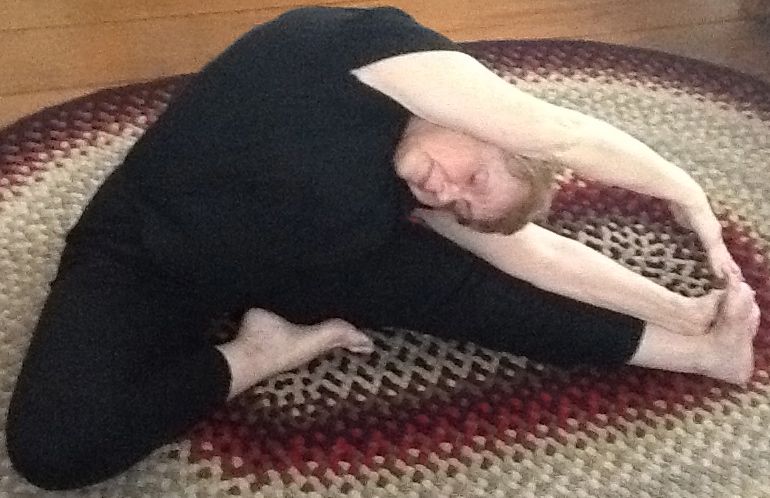
IMG_0805 - Version 2I am grateful to be pain free! I bend double to put on my shoes and go through extreme yoga twists with gratitude for the restoration of my body. I have to smile when the yoga instructors tell us to protect our lower backs because my own experience suggests that it is not the human back that is fragile; it is the psyche.

Over the past several months my back has demonstrated entirely contradictory characteristics.  It has indeed felt fragile, weak, and painful, but it has also felt strong and flexible. To be more precise, strength and flexibility are my back’s normal condition—what you see in the photo is what I could do up to mid-November of last year and what I can do today. But I experienced a six-week interlude in which various sections of my back—low-mid, lower, and right shoulder, in succession—simply stopped normal operations.

Depending on which part was on strike at the time, I couldn’t bend over, twist, or reach higher than my shoulder without risking painful spasms. For a while I could barely walk.

I wrote about this earlier when I had gotten through the worst episode, but that wasn’t the end of it. It seemed that my back wanted to give me a few more lessons so I would really learn what it was trying to say.

You could say that I injured my back and it is now healed. But this simply is not true. Nothing happened to “throw my back out”: the spasms came on gradually. And the restoration of function does not feel so much like healing as a rebound to normal, as if my back just decided to stop making such a fuss.

I also believe that calling this an injury is misleading and downright harmful because it might cause me to treat my back as fragile, in need of protection, and, above all, subject to further “injury.” And when you think it can be injured it will oblige you by taking the next opportunity to do so. It’s a self-fulfilling prophecy.

Dr. John Sarno offers an alternate explanation. The pain and weakness in my various back muscles originated in my brain, which slightly reduced the flow of oxygen to these muscles. Those back spasms were real but they were of mental origin. The cure was two-fold: to physically restore oxygen flow as much as possible through massage, Feldenkrais, and exercise and, more important, to get my brain to stop sending those oxygen-deprivation instructions.

My experience confirms Sarno’s theory that the back pain is a diversion tactic. The mind doesn’t want to face painful, conflicting emotions and therefore lodges its distress in the body.

Over the past six weeks, each time I identified a source of psychic discomfort the pain began to release. But one demo was not enough. One set of pains would go away and another would pop up. Even something as innocent as missing my comfortable home and diet routines while I was enjoying great family time at my son’s house was enough to cause my shoulder to seize up. It did so because I hadn’t consciously acknowledged this particular conflict. When I did, it let go. The situation didn’t have to change; I only had to acknowledge it—and chuckle. Conflicting feelings often get blown out of proportion when they stay underground.

I believe my brain has, at various times in my life, chosen my lower back, my upper back, the skin around my eyes (exzema), my plantar tendon (plantar fasciitis), and the back of my left knee to fool me into thinking my distress is physical rather than mental. This allows me to continue to think that I am a psychologically strong person who can handle anything. Thinking I can handle anything causes me to ignore psychic conflict—especially unacceptable feelings of anger, fear, and anxiety that arise even when I am doing things I want to do with people I love.

These conflicting feelings are inevitable. There is no reason to avoid them or protect ourselves from them. There is no more reason to protect our psyches than to protect our lower backs.

There is every reason, however, to be conscious of them, to grin and breathe deeply and say, hah, that’s happening, I gotcha! And keep our minds, bodies, and spirits moving.

Flow

photo by David Orias

photo by David Orias

I am beginning this year not with resolutions but a theme.

As a Christmas gift, my daughter-in-law, Linnea, enrolled me in an online class called One Little Word. You choose a word that represents something you want to invite into your life and then receive monthly prompts and tools throughout the year that will enhance the concept’s influence on you.

It’s one of those why-didn’t-I- think-of-that ideas. The leader, a woman named Ali Edwards, must be doing very well with it, and deservedly so.

Choosing a word can be a complicated process. When the family was all together in Linnea and Jesse’s new Vermont home over the holidays, Linnea told us how she came up with her word for the year. She set out certain criteria, looked at lots and lots of words, discarding them all, and then suddenly the right one appeared.

Linnea thrives on research. I do not, so I decided not to look for a word until I was good and ready. But once the mind gets something in its head, so to speak, it’s hard to let go.

A day or so after Christmas, when I was meditating and trying not to think of anything at all, words kept floating to the surface. Purpose. Steady. Desire. Finish. And one by one I dunked them down under. They kept coming and I kept letting them go because they weren’t right and I didn’t want to be thinking.

And then the word flow popped up like a bubble and I felt the warm happy in my diaphragm that I’ve come to associate with rightness. I let the word go and finished my meditation but I knew I wouldn’t have to research further.

Other words I’d thought of were should words. I should have a stronger sense of purpose. I should finish what I have started. I should be steadfast, assert my own desires more strongly. Flow, by contrast, represents both my deepest desires and my strengths—my flexibility, adaptability, and desire for harmony and movement. Flow is not only about me as an individual but also about the rhythms in family, community, and life itself.

As a writer I like that it’s both noun and verb, one syllable, and sounds like what it represents.

The cryptic online definitions of flow are good signposts. Consider the rich images of the verb:

  1. Move freely from place to place
  2. Move in one mass
  3. Circulate in body
  4. Be said fluently
  5. Be available in quantity
  6. Be experienced intensely
  7. Emanate as result
  8. Hang loosely
  9. Move toward land (tides)
  10. Change shape under pressure

All of these represent how I want to be and what I want to experience. Only one definition, in the noun form, struck me as totally unnecessary for my life right now: menstrual blood.

A theme song is already running through my head: My Life Flows on in Endless Song.

Healing back pain

healing-back-pain-mind-body-connection-john-e-sarno-book-cover-artSeveral years ago a family member was suffering from debilitating pain in her back and other parts of her body that had built up for months, with no apparent cause or cure. In the course of researching what might be helpful to her, my husband and I came across Dr. John Sarno’s book Healing Back Pain: The Mind-Body Connection. Eventually the philosophy and instructions in that book became an important part of her healing so we’ve been recommending the book to other people, too. We’ve bought a number of copies and given them away or loaned them out. Right now we don’t have a single copy in the house.

Which is unfortunate because I really need it right now. I have been dealing with my own back pain of unknown etiology, as the physicians would say, for the past month.

Here is what I have remembered from the book.

1. Sarno says that back pain and many other physical maladies are psychogenic. Not psychosomatic—“all in your head”; the pain and physical symptoms are very real. But they originate in the psyche. The body becomes the repository of stress and trauma that the mind refuses to acknowledge. When it becomes too much, the body cries out in pain and protest and develops a real malady as a distraction from the subtle pains of the unconscious. “I’m hurting!” is the message, and we assume the hurt is physical—because it is at that moment. But it doesn’t start there, although the body often uses a physical incident or accident or even injury as an excuse to bring the pain to the surface.

2. Psychogenic symptoms tend to come on suddenly, go on a long time or recur mysteriously, and seem disproportionate to any physical trauma. They often move around to different parts of the back or body. They are not continuous, often showing up after you exercise, for example, rather than during the exercise itself.

3. The way to deal with such pain is to bring all our subconscious mental/emotional pain and stresses to awareness. It’s not quite that simple, but almost. Our psychic pain doesn’t even have to be resolved—only acknowledged. And then we can talk to our body pain, telling the aching back, in effect, “There, there. I know that I’ve been dealing with a lot in my life lately—there’s this and this and this that I know of and probably a lot more. I promise to keep these things in my conscious mind and deal with them there. You don’t have to carry them for me.” This acknowledgement—and not any kind of physical treatment, no stretching or relaxation or special exercise—is the key to healing.

That is as far as my memory of the book’s instruction went. So I mined my unconscious for weeks, dredging up all the reasons that my back might have begun twingeing early in November and then seized up seriously after Thanksgiving in painful spasms that came and went so unpredictably that I was on constant alert.

I found plenty of reasons that my psyche could have been generating this pain, and they were all issues I thought I could deal with. But the more I talked to my back, the worse it got. And nothing else helped, either. Not rest, not exercise, not ice, not heat, not meds, not herbals, not, not not. My back was becoming a mass of (k)nots, one gigantic “No!” Every time something seemed to make it feel better, a spasm would come on and I would feel utterly defeated. I felt like I was coming apart in the middle.

I needed help. This past week I scheduled two sessions over three days with my daughter, who lives a few hours away. She is a Feldenkrais practitioner and she has always been able to work miracles with my body. I wasn’t sure she could help me with this, and I knew both of us would be disappointed if these sessions didn’t help. But, God be praised, they seem to have set me on the path to healing, for a combination of reasons.

First of all, she was able to untie the knots that my body had tied around the pain, all up and down my torso, front and back. Until much of the physical tension that had become embedded from a month of pain and frustration—let alone what might have brought on the pain in the first place—was released, nothing could help. This is why techniques like Feldenkrais are crucial in healing back pain. Massage or chiropractic may serve similar purposes.

While she was gently probing my body, Joanna probed my psyche as well with gentle questions, bringing me to a deeper awareness of the causes for my psychic tension as well as my internal resources for healing. This literal joining of the mind and body was astounding, nothing less than miraculous. I was so proud of my wise and gifted daughter. Few healers possess such a combination of skills.

Finally, she helped me remember a key instruction of the book, one I’d forgotten: Don’t give in to the pain. This is important because, although the pain truly hurts, it doesn’t hurt you. That is, the pain does not mean that you are injuring yourself further.

I stood up from her table feeling assembled in an entirely different way but still afraid that the pain would come back. She helped me get over that fear, not by denying that it would return but by finding a different way of meeting it when it did. She helped me summon my inner strength, my inner athlete, the one who could say, “Bring it on! What’s the worst you can do? A few seconds of torture and that’s it!” She encouraged me to breathe through the pain. It reminded me a lot of Lamaze instructions on labor pains. Huff and puff your way through!

I’ve been practicing these instructions for the past two days and they are working. The pain did come back (when I got into the car, when I stood up, when I went up steps, yada yada) and I huffed through it and went right on doing what I was doing. And it didn’t last.

Then I walked two miles late yesterday afternoon, feeling fine, but afterward I hurt a lot. This was a familiar pattern. This time, however, I tried not to let the pain feel like a defeat. I breathed through it. I went to bed early and slept long. This morning I am fine, proof that, whatever last night’s pain represented, no harm was done. I believe I am on my way to healing.

And I just bought the Kindle version of Sarno’s book so I’ll always have it. Why didn’t I think of that before? Duh.

An anniversary and an encounter

photo_2

looking at my CT scan last December with husband and Our Son the Radiologist

A year ago today I almost died in yoga class. Maybe that is why my back has been having severe spaz attacks for the past week, preventing me from going anywhere near yoga class. My health crisis last year had nothing to do with yoga but it is one of those association things. Like, I can never eat M&Ms since I got a terrible stomach upset, probably flu, after eating M&Ms as a kid.

Ah poor back, we have safely made it through the year with no more clots in the lungs so you can relax now.

It does feel better today, and I woke with a great dream this morning. I like this one a lot better than the rat dream I got on my birthday (which was, incidentally, about being kinder to my body).

A charismatic young man who is famous for his humanitarian work is featured in a grand convocation. His work, and perhaps mine as well, is to rescue people one by one. The image is of pulling people across a river with a cable strung from bank to bank. Among the crowds of people at this gathering he singles me out and we make an instant, deep connection. I become part of his inner circle. The dream ends when he puts his arm across my shoulder and says, “We will always be friends, we and our whole families.” I know this involves obligation in the African way but I gladly take it on.

For some reason this dream reminded me of an encounter I had last week with a neighbor.

He came up behind me on his bike as I was walking on the road just beyond the steepest slope of hill in front of our house. “Hello!” he said, and I jumped.

“You scared me. You snuck up on me!” I recognized him as the older man who farms a mile away and runs a stand that sells the region’s best sweetcorn.

“Yeah. I thought I was pretty quiet.” He pedaled ahead of me for a few yards and then turned around and headed back down the hill. “I am walking up Curran Hill for exercise,” he explained.

“Okay,” I said. “Good for you.”

He disappeared down the hill. I was puzzled. He was on a bike. He must have meant he was biking up the hill for exercise.

The hill we live on is the steepest one in the region and we often see bikers practicing on it. Slow, steady up and really fast down. When I bike I prefer to head downhill from our driveway, ending my ride with the gentler climb from the other direction and braking on the steep descent to our drive, which is 2/3 of the way down the hill. The steep side of the hill is a challenge for me to take on the rise. I was a bit surprised that Mr. Vite was up to climbing it repeatedly. But if so, indeed, good for him.

I was taking advantage of the sunny, mild late-November weather for a trash walk. (I could still walk and bend over then.) The roadside was nearly clean because I’d walked it just three days earlier. But in the 2.5-mile roundtrip to Red Bud Trail, I filled a small grocery bag with trash: beer cans, fast food wrappers, and a postcard from Myrtle Beach dated August 16. “Brady. Went golfing today. Saw 8 turtles. Miss you. Sheryl and Rick.” I gather trash out of anthropological curiosity as well as to keep up the neighborhood.

My bladder was calling me home by the time I approached the crest of Curran Hill from the gentle side and began the steep descent to our driveway. I was thus in a bit of a hurry. But there was Mr. Vite again and he was, indeed, walking up the hill, pushing his bike. The bike was apparently for a fast trip downhill to get the effect of a continuous hike uphill with the repeated climbs. Not a bad strategy.

He stopped. “Hello again,” he said. And then he added, “You seem like an outstanding person.”

I did not know how to respond to that but he clearly wanted to talk and I did my best, pinching my legs together. We talked for a minute about exercise and collecting trash and how long I have lived in the area. I was wearing a low-brimmed hat and he apparently didn’t recognize me as one of his customers. I told him I often come by his stand. And then he repeated, “Well, you seem like an outstanding person.”

I did not know what he meant by that or what, in our first encounter of only a few seconds, caused him to draw that conclusion about me (he didn’t recognize me and I didn’t even have the trash bag in my hand…). I wanted to ask but I really did have to go by then and so I just laughed and said goodbye and squirmed the last hundred yards to the house.

Now here is the dream connection. The young man in the dream was my inner Outstanding Person. Maybe he was shining through in that brief encounter.

May we, indeed, be friends forever, we and all our families. Happy anniversary.

Weight loss and violence

The dream I’m going to report is not pretty. But it is instructive on a topic I’ve been thinking about for some time: my split food personality and how it relates to gaining and losing weight.

I have known that rats are in the house but I’d rather not think about them. Then I see one. It is slow and fat so Lalo-cat is able to pounce on it but I can see he isn’t going to kill it. So I stomp on it with my foot and hold it down, looking for something to kill it with. There is rubble around. I try whopping it with a stick but that isn’t going to work. Then I drop chunks of concrete on its head, my foot still holding down the fat body. That doesn’t work well either. But by the end of the dream the rat is looking sorrier and sorrier, maybe dying a slow death.

I was totally baffled by this dream until my spiritual director read it back to me and asked me to think about the rat as myself. Oh yeah. “Slow and fat.” “Fat body.” That’s the Fatty in me, the one I have been calling “Stuffer.” I had really been hoping to do away with Stuffer once and for all. This dream is about my latest effort to lose weight.

Over the years I have learned to know Stuffer quite well. Stuffer lives in my mouth, not in my stomach. Stuffer gets hungry but not the way the stomach gets hungry. She is tuned into my emotions, not my body. She gets hungry for stimulation when she is bored, company when she is lonely, consolation when she is upset, celebration when she is happy, calm when she is stressed, energy when she is tired. Stuffer tends to address all these needs with food (and drink), although most have nothing to do with food.

Certain foods are especially pleasing to Stuffer-in-the-Mouth. Although she enjoys a hit of carrot cake with cream cheese frosting now and then, she is basically a salty-fatty girl, not a sweets craver. Cheese and crackers, chips and dips, KFC—oh my.

Because Stuffer lives in my mouth she tends to ignore the signals of the stomach until too late. Stuffer has a lot of problems with heartburn.

Stuffer is not only hungry in all these ways; she is also afraid of being hungry. She fears not getting enough to eat so she hesitates to share a restaurant meal. At home she always has seconds, on principle. She fears going to bed hungry. She snacks all evening.

After many months or years of this, Stuffer gets slow and fat, like that rat.

And I get fed up, literally.

I put my foot down (ouch).

And I switch into Healthy Eater mode: Calorie- or point-counting. Portion control. Lots of fruit and veggies. Yada yada. We all know the drill.

After a few weeks in full-time Healthy Eater mode I have all but forgotten about Stuffer. Gone are the cravings, gone the evening snacking, gone the heartburn. Healthy Eater is tuned into the whole digestive tract, not just the mouth. Healthy Eater is more afraid of feeling too full than of going to bed hungry. She looks with horror on large plates of foods glopped with cheesy fat. Because of body awareness, Healthy Eater does a pretty good job of separating emotional ups and downs from eating. She eats when she is hungry and is grateful to be satisfied and no more.

And thus, the Stuffer pounds begin to drop away.

What happens, of course, is a shift in body chemistry as well as body awareness. When you wean yourself off of carby-fatty excess you influence that complex set of hormone signals that suggests what you want to eat, how much, and when. Willpower is involved at the beginning but the need for willpower tapers off as the hormones do their thing. And sometimes the shift is sudden, like flipping a switch. That is very cool. This happened for me on that 3-day juice fast that launched this latest weight-loss campaign, which is progressing nicely and gradually as I continue in Healthy Eater mode, with the Weight Watcher point system keeping me honest.

But my dream was showing me something else that I hadn’t realized before. Which is that all of this involves quite a lot of self-loathing. And that includes both personalities.

While I like being Healthy Eater, I don’t much like her. She is a bit of a weenie, self-righteous and judgmental; a foodie know-it-all who can’t understand why anyone would want to eat those plates piled with cheesy fried stuff; a thinning person who feels superior to all the fatties she sees around her.

And I really don’t like Stuffer. I find her disgusting and pathetic. I want to get rid of her. I, in Healthy Eater mode, would like to hold her down and drop things on her head. Like that poor chubby rat.

Whew. The violent aspect of weight loss?

I resolved to try to make Healthy Eater a little kinder. Try a little tenderness with Stuffer, who is, after all, an emotional gal.

This week at a local restaurant Healthy Eater allowed Stuffer a piece of raspberry cream pie after choosing the chicken noodle soup for herself (both agreed that neither was that good). We have stocked up on treats: Hummus to glop on thin crackers. Dove Promises (dark chocolate, 1 point apiece). Mixed nuts (good protein with the salt and fat). Weight Watchers big latte bars. And Stuffer’s favorite, popcorn—nutrient-free but harmless.

Tonight, while the husband is still out of town, dinner will be a judicious, point-controlled assortment of snacks.

Wisdom v. struggle

photo by Nina B. Lanctot

For the third time in the last 12 months I have gotten the Wisdom v. Struggle essence in the personal blend my daughter prepares for me intuitively.

How many terms should I unpack and explain before I go on? “Essence” refers to a preparation an herbalist (in this case Merri Walters of Great Lakes Sacred Essences) makes from flowers or under the influence of places or celestial events. Essences have energetic properties linked to healing and influencing human emotions and development.

“Personal blend.” My daughter sometimes makes individualized blends of these essences for people who request them.

“Intuitively.” She makes her choices based on the energetic sensations she receives at the moment, from individual bottles in her collection, not on her knowledge of what the individual might need. Whatever the mysterious process involves, it works. The blends she makes for me are always spot-on, appropriate, revelatory.

I experience these personal blends as catalysts. They make things happen in my life and psyche that need to happen. They are not always soothing but they help produce profound, necessary change. The plants, rocks, and waters they represent have become my allies on my life journey.

So when “Wisdom v. Struggle,” drawn from the waters of Lake Superior, shows up three times in a row out of several hundred possibilities, I pay attention.

I like the first part of Merri’s description of this essence’s properties:

This essence is for those who are truly ready to see, who are no longer afraid of the unknown but are ready to sit peacefully and watch the great mysteries unfold…..no longer distracted by the irritations of this plane…..profound peace, the doorway to initiation and the mysteries of the cosmos.

Yes, yes, that’s me! I’m there, baby.

But she goes on:

This essence can also be extremely helpful to those who are still caught up in struggle, who seek wisdom, seek depth, seek to know the truths of all time but as they find themselves in perfection ~ their hearts desire ~ they become preoccupied by the flies that are there too.

Alas, that is also me. I am often preoccupied by flies.

The gray brown chill of November. The roofer who took our deposit and disappeared. My husband’s absence on my birthday. The prospect of a difficult conversation with a friend. Climate change. Whether the turkey that’s been in the freezer for a year will be all dried out and I should get another one for Thanksgiving. A low-energy day.

(What is it about the state of the world and the small disturbances of everyday life that makes these things weigh heavily, and equally, on a given day?)

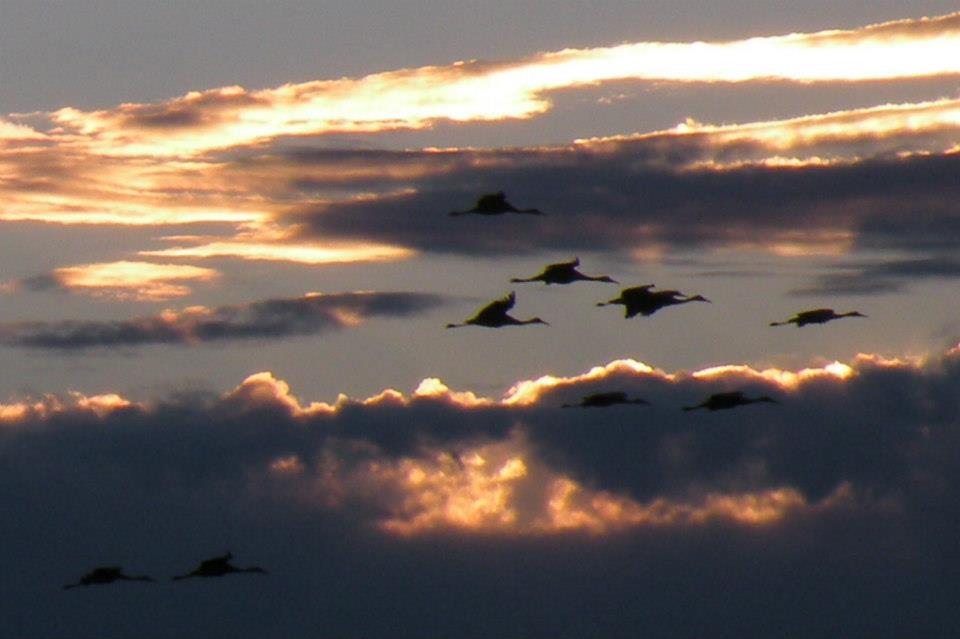
On Saturday I asked for a special early birthday celebration, a visit to Jasper-Pulaski State Park an hour and a half away in Indiana to see the migrating Sandhill Cranes.

The cranes come through this area every year on their arduous trips, feeding and socializing for several months in the area. They gather by the thousands at dusk in large pastures in the park, where you can watch flocks soaring in just before sunset, a great bird O’Hare Field at rush hour. They socialize there for a little while then lift up en masse, sometime after dark, to roost in nearby marshes. They sleep with their feet in cold water. They get together in the pastures again at sunrise.

We watched the cranes flying in until we couldn’t stand up anymore, then ceded our choice viewing spot on the platform to people who were crowding in behind us, gabbling like cranes. Look at that. There come some more. And more! See that big bunch! See how they put their feet down. Ah, ahh, zoom zoom! They make it look so easy.

I thought of Wisdom v. Struggle. I thought of how I wanted to live like a crane, soaring with the thermals, landing on my feet, hanging out with the community. Following the journey where it takes me.

Sunrise. Photo by Nina B. Lanctot


My weight-loss mythology

I am losing weight. Yay, hurray! Twelve pounds in eight weeks. In this process I am discovering and deconstructing my own mythology about weight loss.

Myth number 1: The older I get, the harder it is to lose weight.

I am actually losing weight at nearly the same pace that I did in my 40s, on the same program, Weight Watchers (following a short juice fast).

It is true that I gain weight more easily as I age. I could probably put those 12 pounds back on in about two weeks. It is also true that my body is less forgiving of any slacking off. I rebound a bit after every weekend indulgence or day with no exercise. The rebound usually comes 3–4 days later.

Myth number 2: I can take the weight off just by exercising more.

For one thing, my increasing weight depleted my energy so it was becoming a chore to exercise every day. But even when I did, like last year when I was training for a century bike ride, my weight stayed steady. I need to follow the tried and true prescription of less food and more exercise.

The good thing is that as I lose weight I get immediate feedback in the form of increased energy and this makes it possible to exercise more. That energy gain is much more noticeable than it was when I was younger. The sensation of increased energy makes exercise extra rewarding. Yesterday I swam laps for a full hour and felt I could go on forever, at my sedate pace of 30 laps an hour. But lap swim was over at the Y and the kids were jumping in.

Myth number 3: I know how to eat in order to lose weight and maintain weight loss.

I am a good cook and have long followed a fair approximation of the Mediterranean diet: lots of vegetables, fruit, whole grains, a little protein, olive oil, very little dairy, red wine. I did not need to change what I eat; only how much. And I also needed to greatly cut down on the exceptions I had been making to this good diet. I made plenty of exceptions, especially when I ate out.

I am not good at estimating portions or paying attention to when I am full. This is where Weight Watchers comes in. (I do it online; I hate those meetings with testimonials and cheers for every half pound.) It introduces mathematical certainty to portion control and food choice. You can make exceptions to healthy choices but they take your point quota down fast. With a little forethought and calculation you can indulge in anything you want. But it is safer to stay with really healthful food.

I was shocked to discover how much I had been overeating—and, on the positive side, how happily I could survive on much less. Hunger has not been a problem.

I do not want to sound like a commercial for Weight Watchers. I enjoy “tracking” in a peculiar way. This may be a drag for others. I find, as I did years ago, that the program is, if anything, too lenient. I would never lose weight if I ate all my bonus points or exercise points. I have to stay close to the minimum daily allowance. And I may have to track points the rest of my life (sigh) because when I stopped, I regained the weight and more.

There is something more involved in all this, however; something at the intersection of spirit and body. I will explore it in another post.

Compassion for my left side

Today while I was meditating (and thus not supposed to be noticing anything) I noticed that every time I started pursuing a thought my left shoulder tensed up. Releasing the thought required releasing my left shoulder. What is this about? I wondered. And I released the thought, and my left shoulder.

After the meditation I began journaling, which I do on my computer. And I noticed, not for the first time, that my left arm and shoulder tensed up while I was typing while my right arm and shoulder stayed relaxed. My right hand danced over the keys. My left hand was not dancing. It was trying to but it felt clunky, as if it might step on its partner’s toes at any moment.

I am right handed. Everything is easier for my right hand. But certain tasks, like typing, which I do sometimes for hours every day, require equal performance from my left hand. My poor left hand has to scramble to keep up. The extra effort causes tension.

My left side is the not-so-talented twin trying to measure up to the standards of her more gifted sister. In so doing she acquires a residue of tension that never really goes away. It extends to my left leg, which currently carries the remains of a knee injury that happened months ago. Every time I do yoga balancing poses I am reminded of the inferiority of my left side. It is weaker, less coordinated. I topple over much more quickly when I am standing on my left leg.

This has been happening all my life. I have known it but I have never paid attention to it. I have been dismissive about it. I have not paid true attention, which requires receptive curiosity and even compassion.

This thought (which I have just pursued as the tension builds in my left shoulder) brought me to the question of whether something more than actual inferiority of function is involved. Could it be that my left side has an inferiority complex?

That is, the constant, inevitable comparison with my right side causes my left side to expect itself to fail to measure up. It expects to have to try harder and thus experiences a kind of neurotic desperation. It can’t relax because it is always ready to spring into action. Even when I am meditating, as the thought process starts up the left shoulder tenses in the expectation that it will have to perform in some way.

I know some people like that. Sometimes I am like that.

Poor, dear left side. I will try to pay compassionate attention to you for a while and make amends for criticizing you, dismissing you, expecting things of you without appreciating the extra effort they require. What do you require?

By the way, if you suspect that writing about my left side, boring car trips, and losing weight indicates that my life is pretty quiet right now, you are right. Not much happening. You could call these posts, How to Write a Blog out of Nothing, which may have a certain appeal, given that my most popular post of all time is one called How to Make a Meal out of Nothing.

But I would really like to know what my next big thing will be. I have some ideas but they haven’t come together yet.