My Next Big Thing

The truth is, I’ve hit a snag. Flow stopped, motivation gone, I am at a loss for what to do next. I’m retired, I can do what I want, but that is easier said than done. What do I want?

On this warmer but still gray afternoon in early April, with only a hint of green and hepatica (yay, hepatica!)  in the forest leaf cover, I feel like I have started a thought and lost it, mid-sentence. What were all these plans I had as recently as January 1? I had what I thought was a year’s worth of desires lined up. All I had to do was follow through.
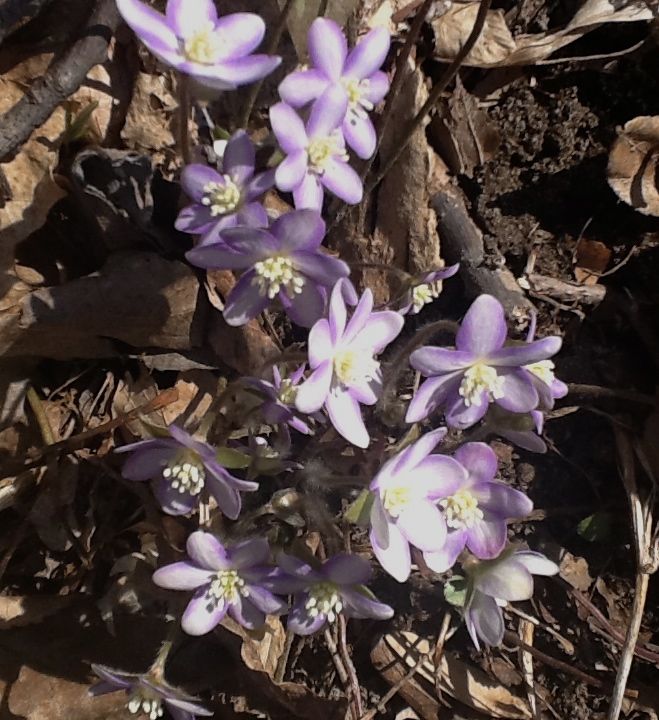
hepatica

Yay, hepatica!

Maybe it wasn’t a year’s worth; maybe only three months’ worth.

No, that’s not quite right. Some of those plans are accomplished, ta-da, done! Or almost. I work really fast when I put my mind to it. Others are not yet fully executed. I have done the easy parts and many of the hard parts but now there are some really hard parts left and I am running out of steam.

In the accomplished column is the publication of a book that I thought I would never finish writing and revising, let alone publish. Ta-da, done! I did this much faster than I thought possible and had fun mastering self-publishing, which has come a long way in the last few years.

In the nearly accomplished category: weight loss. I thought I couldn’t do it and then I did it. Ta-da, goal in sight!

Yet to do: get back to biking. But I have made progress by finding the guy who will help me get on the right bike. I will visit that shop outside Detroit again in the next month. Meanwhile, I will start to toughen my butt on my old bike as soon as the conditions are right. (I require temps in the 50s or above but not too hot, no rain, not too much wind. Today is a tiny bit rainy and besides I already got my exercise at the Y.)

However, what is really bothering me on this too-open afternoon, making me feel like a cowardly, unmotivated lazybones, is that I haven’t yet started my Next Big Writing Project.

But come to think of it, that’s not true. I have started the project but it is not yet at the writing stage.

  • I think I know what it is. I want to write about Mennonites in Congo and the power of music and faith in some of the toughest circumstances on the globe.
  • Since making two trips to Congo last year, I have been working on developing a special relationship between my church here and a congregation in Kinshasa.
  • I have revived the Congo Cloth Connection to create relationships and fund projects for women and children in Congo–we’ll do another big cloth market at the Mennonite Church USA convention in Phoenix in July.
  • And I am starting to think about my next trip to Congo.

I am hung up on this last point, however, the next trip. This will be a trip I do entirely on my own except my husband will go with me this time. But no sponsoring project, no special occasion like a centennial celebration, no fellow travelers. I want to go to visit churches and listen to as many choirs as possible. I want to go to write. This would be a research trip for my Next Big Writing Project.

There is a gap between the desire to do a thing–go to Congo on our own and listen to choirs–and making that happen. It is in this gap that the desire begins to doubt itself. Do I want this badly enough to do everything it takes to make it happen? All the money, logistics, contacts needed to travel in that compelling, outrageous country. Just for me. Just to write.

I need to believe in myself both as a doer and as a writer in order to move off square one. I am writing this as a statement of intention. If you wish, hold me accountable. Cheer me on.

First Things first

There are so many things I have to do first thing in the morning.

I have to have my tea.

I have to have my breakfast and take my meds.

I have to have my fire in winter and it is still winter.

I have to satisfy my curiosity about the world and my friends.

I have to meditate.

I have to journal.

I have to do my alignment exercises.

That last thing, the alignment exercises, is the newest First Thing I’ve introduced into my morning but I’ve noticed that recently it has fallen by the wayside.

There is no order to these things; it’s more like, I have to do each one of these things first. So many morning urgencies.

When I look at this list I understand why the new morning practice of exercises has gotten lost. Why do I think I have to do them first thing in the morning? Because the guy who wrote the book said I should. “Do these exercises first thing in the morning so you get the benefits all day.” Of course.

Same thing with the journaling. I subscribe to Julia Cameron’s Morning Pages theory, expounded in The Artist’s Way: that writing just after rolling out of bed gets your creative juices flowing and of course if you have had dreams that is the time to get them down.

And I also believe that the day should begin with God because (apologies to God and Coke) Things Go Better with God. So I do want to meditate for 20 minutes. First thing.

However, if I listen to my sleepy mind and spirit and my chilly body, I really want that hot tea and warm fire first. And I have to take a daily pill before I forget and it has to go with food so I make and eat breakfast while I’m at it. So that’s three First Things right there.

fire

If Hazel were here she would trump all First Things but she isn’t and Vic isn’t and so today I have only the fire.

And if I open my computer to journal, how can I avoid checking email, news headlines, and Facebook? This is just normal human curiosity. Maybe this is why Cameron was pretty adamant about Morning Pages being written by hand. But The Artist’s Way was written pre-Facebook. She just thought creativity demanded handwriting. Not for me. I’ve been journaling on the computer for 15 years. This is especially important now because if I start journaling something cool I can ease right into writing a blog post, which is what I am doing right now.

So blogging inserts itself as yet another First Thing today. Plus, I really intended to carry the laundry basket down to the basement and start a load of laundry First Thing so it could dry on the racks during the day but by the time I’d pulled my clothes on and remembered to put in my hearing aids (another First Thing) I forgot the laundry.

laundry

Just as well because yet another First Thing was calling me as I looked out the window and saw yet another lake-effect snow decorating the landscape on this First Day of Spring and I just had to get that picture on Facebook First Thing, before anyone else did.

snow

And while I was taking pictures I noticed my iPad had captured a nice view of my kilim that didn’t show the dirt.

kilim

But before posting to FB I had to check if anyone else had posted the snow and they hadn’t, but I read what they had posted including some articles. And of course I checked email.

But before that I did make the tea and my breakfast smoothie (recipe below) and the fire so I could be warm and cozy and optimistic while I held my warm Mac on my lap, surfing and writing. And I shared a tiny bit of milk with the cat (whole milk for my tea is my daily deviation from my Lenten vegan diet).

So I have been up for a couple of hours and still have a number of First Things to do, including meditate.

Fortunately I don’t have to go to work anywhere or get any kids ready for school or walk down to a river to get water or any of the other First Things my sisters around the world have to do.

African

Photo by Kongo Lisolo

But I think I need to find another slot in the day for those alignment exercises. It’s almost lunchtime.

First Thing in the Morning Smoothie Which Tastes Better Than You Think

Blend in the food processor:

1 cup raw oatmeal

2 T ground flax or whatever healthy additives you are into (I add a green veggie energy powder which makes this smoothie ugly brown)

1 orange

a handful of berries (I like frozen blueberries)

some applesauce or a banana

a splash of whatever milk you are into, or unsweetened yogurt

This serves two, or you for two days. The oatmeal gets even thicker by Day Two.

A lost dream

This morning I woke with a stressful dream about being in a barren, cement barracks with a group divided into men and women. We all have to take showers, get dressed, and get to a choral rehearsal across an unknown city, by unknown means, by an unknown but precise deadline. I get into the wrong bathroom, the men’s, and then get to the women’s but have to get something in a room and then can’t find the bathroom where I’d left my towel. Many more complications. I may not get the shower. I am wearing a long yellow dress with navy patterned tights and cloddy shoes. Will it do? I wake searching and searching.

This has echoes of the terrific novel I’m reading, The Orphan Master’s Son, which is getting more and more disturbing as it progresses. But the most distressing thing is that this frenetic dream wiped out a dream image from the middle of the night that I felt was important and that I surely could remember though I didn’t wake enough to write it down.

I lose dreams all the time and I always regret it. What treasure of wisdom or entertainment is now lost to me forever because the bubble burst before I could capture it in my memory?

Yesterday, though, I found a dream that had gone missing and it really was important. It belonged in my book, The Dream Matrix, but it ended up on the cutting floor in my last revision. Without it some later references make no sense.

When I discovered the mistake I immediately revised the book. This is one great advantage of self-publishing. The changes get registered almost immediately. If you already have a copy of the book and would like to have the missing dream, email me at njmyers@mindspring.com. It goes into the first letter in Chapter 3.

This discovery just goes to prove my own maxim that even a great editor (which I am) needs an editor. I dare you to find a typo in this book! And it reads really, really well. But earlier I almost ended up with two chapter fives.

I didn’t discover the missing dream. My wonderful writing mentor, Deena Metzger, who had read earlier versions of the manuscript, pointed it out. She actually remembered the dream, as I did—it was still in my head, which was why I didn’t notice that it had gone missing in the final revision.

Like any great teacher she tacked the note about the missing dream as a P.S. onto an ode of praise for the book. She claims she says these things not because she knows and loves me or because she is connected to the book:

I finished your book yesterday.  I had read it, rapt, whenever I could during the day. It is an extraordinary text.  Beautiful. . . .  And brilliant.  Startling in its insight, perception and intelligence. . . . We, readers, know at the end something of the possible range of what it means to be human, the potential for extraordinary understanding and accomplishment despite, or because of, the struggles and difficulties that we all encounter.

[As] one who was present for some of this and has read much of it before [I am] awed, really, by your ability to render the great mystery of connection with so much light and so lightly.  By your ability to render the great mystery of connection!  I am and am not surprised that Spirit would challenge two women who were raised in and practice a soulful religious path to see what else exists, how else Spirit moves in the world so that Spirit’s ways might become known so that we can begin to live accordingly.

Dream and daily life, religion and Spirit, meanness and generosity, possibility and devastation, dolphins, beached and leaping, Aberdeen and sacred trees, the grove restored, hard and relentless work about nuclear and environmental danger, the world restoried, and friendship, friendship, friendship, and love in so many of its forms, lived truly and passionately from the heart.

These words do not come close but your words do come close.  I will try to find the right words to honor your heartfelt work. . . .

I want everyone to read the book so they will know what writing is and can be, also, what might happen in a circle, what might come to be if one gives oneself, despite or through, skepticism, to everything that is indeed occurring and related in the holy universe that is without limitation.

If you aspire to write soulfully and for the soul of the world, you should work with Deena. If you want to know what that is like, read this book. You can start by telling and writing your dreams to a friend.


Lenten fast food

“Remember you are dust and to dust you shall return.”

The phrase struck home when we were marked with ashes on Ash Wednesday. Vic had just received some bad numbers from his physical exam. His blood pressure and blood sugar were both elevated despite regular exercise, a healthy diet by most standards, and very little excess weight. And we’re 68. So we were thinking about mortality.

He was in the mood to try something drastic rather than go on more medication, so on Ash Wednesday he was already in the middle of a juice fast, glugging down the life-force from pounds and pounds of vegetables and a few fruits every day. Meanwhile, I’d become aware of my own sensitivity to wheat and dairy and we’d already cut back on that, though I usually kept some regular bread around for Vic. So some signs were pointing us toward vegan gluten-free.

The beginning of Lent presented an invitation to conduct a physical and spiritual experiment. Could we bring Vic’s numbers down by subtracting some foods rather than adding medication? Could this practice enhance our spirits as well as our bodies? Oh, and throw in consideration for the earth and the community, too, as well as each other.

Lent seems a time to experiment with being really, really good. It is not so much about giving up as bringing awareness and attention, preparing, making an offering. We are bringing awareness to the food we eat, consecrating it as the sacred gift that it is. We are bringing attention and respect to the sacred gift of our bodies. And we are preparing for the final stage of our life, which will end in our death.

How’s it going?

After less than a week of juicing and then vegan gluten-free, Vic’s blood sugar had dropped 22 points to near normal. No other dramatic physical changes to report–my weight loss continues at the same tortoise pace as before. But the physical experiment seems to be working.

The spiritual challenge is more interesting. Can I, the cook, produce abundance with a much more limited range of ingredients? What about hosting–that is, sharing such abstemious abundance with others?

I don’t like following recipes but I’ve had to look up a few to get started. I won’t even share them with you because I altered them hopelessly even the first time I tried and I can’t remember exactly how. My meals are like snowflakes–no two alike.  Taste until it’s good. But here is a site that got me putting together some interesting soups and stews. I tend toward one-dish things.

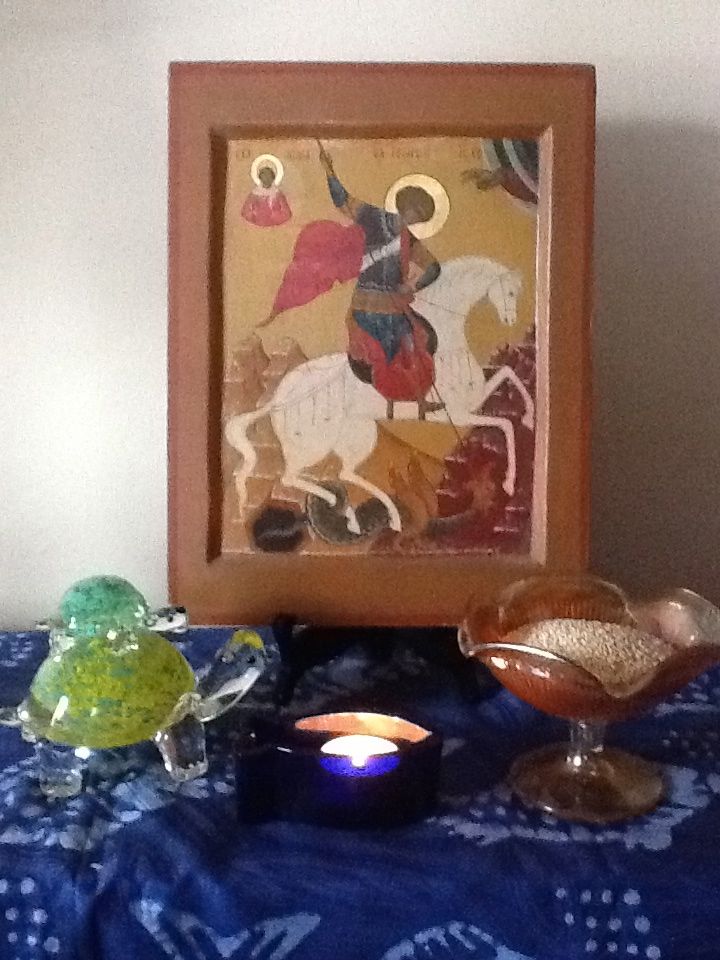
After 10 days neither of us is missing meat or anything else that we have “given up.” (Did I say we almost never eat soy, either? Because of the estrogens.) We are developing a new respect and gratitude for beans, grains, and veggies upon veggies. I have made a Lenten altar with my St. George icon, saint of the aggressive approach I guess. I offer some food there every day. A bowl of amaranth. The squash for the soup I made yesterday at a friend’s house.  A new hummus I figured out myself.

IMG_0846

George with weight-loss tortoises and quinoa

The other part of the Lenten offering is sharing with others. The friend, Sarah, had said last Sunday she was too busy to shop for and cook healthy meals so I offered to cook for her. Yesterday I took the ingredients for a roasted squash soup, vegan cornbread, and salad, and we cooked them up in her kitchen. It took a while. Lenten “fast” food isn’t fast.

And it wasn’t for everybody. Her husband praised the soup but he’d prepared a meat dish for himself because he couldn’t imagine a dinner without meat. I was outside my comfort zone trying unfamiliar recipes in someone else’s kitchen. I’m not sure they were up to my usual standards.

But this is less about standards than about trying, about offering and sharing and enjoying. We had a great evening. The gluten-free vegan no-soy Lenten fast is becoming the Lenten feast.

Picture your soul

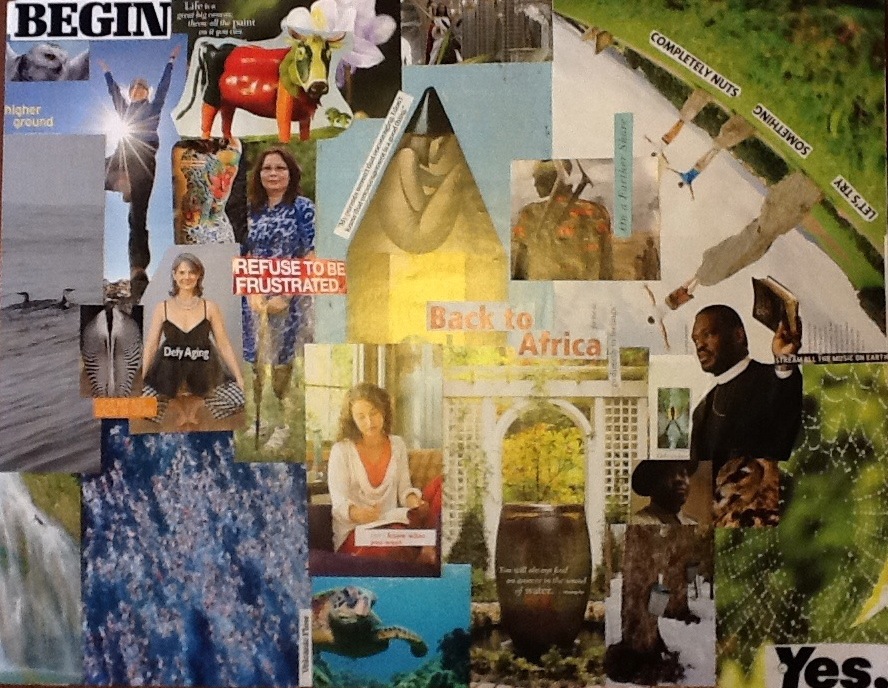
vision board

This is a snapshot of my soul right now. Some call this a vision board. I put it together intuitively, thumbing through magazines and clipping pictures and phrases that grabbed me, things I felt where I feel rightness, right around the solar plexus. The gut brain.

I am happy with it. Looking at it makes me happy. I learned things I didn’t know before I did this, like how strong my desire is to go back to Africa, and I relearned things I have known for a long time, like that my soul-medium is water. The sperm-like creatures in the blue picture toward bottom left are swimmers in a triathlon, photographed from a helicopter. My favorite text in the collage is, “You will always find an answer in the sound of water.” It is on the urn fountain at bottom center. Beside it are maple trees hung with buckets. Right now the sap is about to run in the family maple woods 50 miles away. Drip, drip, drip.

In case you are curious about some of the other text too small to read here is some of it:

Life is a great big canvas; throw all the paint on it you can.

Let’s try something completely nuts

Got my ass back in gear (zebra)

My parents weren’t that encouraging. I don’t know that encouragement is a good thing. (girl in the pencil)

Step 1: know what you want (girl with journal)

In the end the love you take is equal to the love you make (tattooed girl).

Although I wasn’t aware of any intentions or meanings when I made my selections, I could tell you now exactly why I chose each picture and phrase, exactly what each one means to me. This is the kind of work I like to do, bringing subconscious knowledge and desires to consciousness. It is dream work, art, writing. Revelation excites me, even–especially–when it concerns something I have known all along. It is one reason I read so many novels. I want to see what writers know about the human experience that I also know or suspect.

I think this is the way with any learning. We learn what we already almost know. For a long time we know in part and then suddenly we know fully. We see through a glass, darkly, and then face to face. We know pieces of the puzzle and then glimpse the whole.

It’s like my granddaughter, two and a half, who has been learning to count. For months she faltered around 5 or 7 or 8 in both of her languages and began mixing up the order. The other day, her mother reports, as she was riding in the car with Mommie, Baba, and Nai-Nai, she opened her mouth and counted from 1 to 10 perfectly in Mandarin and then in English.

Her sudden mastery may go underground again before it is solid in her consciousness. We forget what we know but it is still there and we relearn it. What fun it is to delve into your own psyche and to bring out the beautiful collection of things you know and love and believe and desire. I highly recommend this exercise.


Communal dreaming

Dreamfinal

Coming soon!

I have been working on a memoir very off and on for years. I will soon be ready to put the e-version out in the world though the print version will take more time. I’ll let you know.

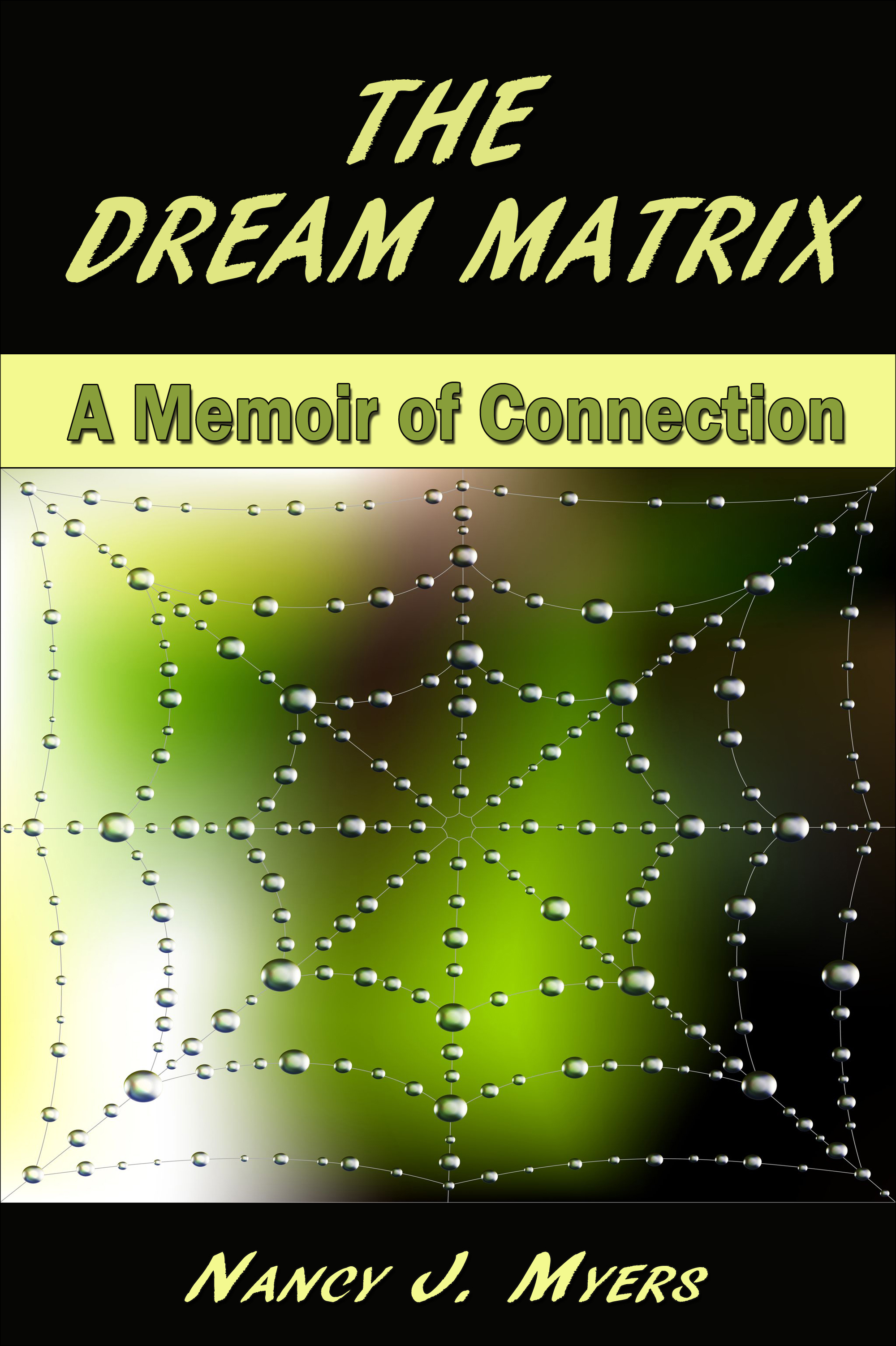
It has taken so long because it is a complicated story. It’s called The Dream Matrix: A Memoir of Connection. How do we actually experience mystical connection with other people and with the Divine? This story is about several threads of my own experience with that, especially communal dreaming. This is what I call night dreams that cross boundaries, becoming a conversation with and for a friend or a community, often moving in the realm of divine mystery. The memoir contains many examples of such dreams and the art of interpreting them.

Communal dreaming harks back to stories in the Bible—Joseph, Jacob, Daniel, and many others dreamed for a community and interpreted the divine messages of dreams. And I consider this story part of my personal “Bible story.” It has also spawned sacred stories for other people and several communities, including the church of which I have been a member for more than 30 years and even the environmental policy community.

Every time—every time—I take this story up to try to finish it, it goes into action again, creating new chapters. That is, I start having dreams again and they take on a communal character. On the one hand this confirms the basic truth of the story but on the other, it’s frustrating. The story keeps squirming out of control, declaring that it has no end. Nevertheless, I’ve limited the memoir to two such periods in my life, ten years apart.

This month as I have been working on the book it has happened again.

Church has been a theme of my life in January. My husband and I are saying goodbye to our longtime Chicago church and becoming members of the church we’ve been attending in our new community 100 miles east of Chicago. I am also helping establish ties between this congregation and a congregation in Kinshasa, DR Congo.

That is, I am transferring church membership and pursuing church-to-church relationships. When you put it that way it sounds dry and institutional, and we churchy Christians often speak in such cryptic, neutral language. We even act as if these were decisions of the head, ones that can be worked out in logic and meetings. But the heart speaks in dreams.

One day last week we met with our new pastor to discuss membership. The same evening I attended a meeting about the Congo relationship. That night I had a pair of dreams about two flocks of very large, beautiful birds. One flock looked like sandhill cranes—birds I associate with the Midwest—but they were in Africa. The other flock was a gorgeous variety of flying ostriches—birds associated with Africa—but they were landing at a set of church retreat buildings in the US, bringing astonishing beauty to a rather drab, institutional center.

I welcomed these dreams as transcendent gifts. They confirmed the rightness of my decision to join a new “flock.” They also symbolized the exchange, the relationship of these beautiful flocks from different cultures and continents.  I may tell the dream next Sunday as my faith testimony when I join the church. Who knows? New Bible stories may unfold.

Flow

photo by David Orias

photo by David Orias

I am beginning this year not with resolutions but a theme.

As a Christmas gift, my daughter-in-law, Linnea, enrolled me in an online class called One Little Word. You choose a word that represents something you want to invite into your life and then receive monthly prompts and tools throughout the year that will enhance the concept’s influence on you.

It’s one of those why-didn’t-I- think-of-that ideas. The leader, a woman named Ali Edwards, must be doing very well with it, and deservedly so.

Choosing a word can be a complicated process. When the family was all together in Linnea and Jesse’s new Vermont home over the holidays, Linnea told us how she came up with her word for the year. She set out certain criteria, looked at lots and lots of words, discarding them all, and then suddenly the right one appeared.

Linnea thrives on research. I do not, so I decided not to look for a word until I was good and ready. But once the mind gets something in its head, so to speak, it’s hard to let go.

A day or so after Christmas, when I was meditating and trying not to think of anything at all, words kept floating to the surface. Purpose. Steady. Desire. Finish. And one by one I dunked them down under. They kept coming and I kept letting them go because they weren’t right and I didn’t want to be thinking.

And then the word flow popped up like a bubble and I felt the warm happy in my diaphragm that I’ve come to associate with rightness. I let the word go and finished my meditation but I knew I wouldn’t have to research further.

Other words I’d thought of were should words. I should have a stronger sense of purpose. I should finish what I have started. I should be steadfast, assert my own desires more strongly. Flow, by contrast, represents both my deepest desires and my strengths—my flexibility, adaptability, and desire for harmony and movement. Flow is not only about me as an individual but also about the rhythms in family, community, and life itself.

As a writer I like that it’s both noun and verb, one syllable, and sounds like what it represents.

The cryptic online definitions of flow are good signposts. Consider the rich images of the verb:

  1. Move freely from place to place
  2. Move in one mass
  3. Circulate in body
  4. Be said fluently
  5. Be available in quantity
  6. Be experienced intensely
  7. Emanate as result
  8. Hang loosely
  9. Move toward land (tides)
  10. Change shape under pressure

All of these represent how I want to be and what I want to experience. Only one definition, in the noun form, struck me as totally unnecessary for my life right now: menstrual blood.

A theme song is already running through my head: My Life Flows on in Endless Song.

An anniversary and an encounter

photo_2

looking at my CT scan last December with husband and Our Son the Radiologist

A year ago today I almost died in yoga class. Maybe that is why my back has been having severe spaz attacks for the past week, preventing me from going anywhere near yoga class. My health crisis last year had nothing to do with yoga but it is one of those association things. Like, I can never eat M&Ms since I got a terrible stomach upset, probably flu, after eating M&Ms as a kid.

Ah poor back, we have safely made it through the year with no more clots in the lungs so you can relax now.

It does feel better today, and I woke with a great dream this morning. I like this one a lot better than the rat dream I got on my birthday (which was, incidentally, about being kinder to my body).

A charismatic young man who is famous for his humanitarian work is featured in a grand convocation. His work, and perhaps mine as well, is to rescue people one by one. The image is of pulling people across a river with a cable strung from bank to bank. Among the crowds of people at this gathering he singles me out and we make an instant, deep connection. I become part of his inner circle. The dream ends when he puts his arm across my shoulder and says, “We will always be friends, we and our whole families.” I know this involves obligation in the African way but I gladly take it on.

For some reason this dream reminded me of an encounter I had last week with a neighbor.

He came up behind me on his bike as I was walking on the road just beyond the steepest slope of hill in front of our house. “Hello!” he said, and I jumped.

“You scared me. You snuck up on me!” I recognized him as the older man who farms a mile away and runs a stand that sells the region’s best sweetcorn.

“Yeah. I thought I was pretty quiet.” He pedaled ahead of me for a few yards and then turned around and headed back down the hill. “I am walking up Curran Hill for exercise,” he explained.

“Okay,” I said. “Good for you.”

He disappeared down the hill. I was puzzled. He was on a bike. He must have meant he was biking up the hill for exercise.

The hill we live on is the steepest one in the region and we often see bikers practicing on it. Slow, steady up and really fast down. When I bike I prefer to head downhill from our driveway, ending my ride with the gentler climb from the other direction and braking on the steep descent to our drive, which is 2/3 of the way down the hill. The steep side of the hill is a challenge for me to take on the rise. I was a bit surprised that Mr. Vite was up to climbing it repeatedly. But if so, indeed, good for him.

I was taking advantage of the sunny, mild late-November weather for a trash walk. (I could still walk and bend over then.) The roadside was nearly clean because I’d walked it just three days earlier. But in the 2.5-mile roundtrip to Red Bud Trail, I filled a small grocery bag with trash: beer cans, fast food wrappers, and a postcard from Myrtle Beach dated August 16. “Brady. Went golfing today. Saw 8 turtles. Miss you. Sheryl and Rick.” I gather trash out of anthropological curiosity as well as to keep up the neighborhood.

My bladder was calling me home by the time I approached the crest of Curran Hill from the gentle side and began the steep descent to our driveway. I was thus in a bit of a hurry. But there was Mr. Vite again and he was, indeed, walking up the hill, pushing his bike. The bike was apparently for a fast trip downhill to get the effect of a continuous hike uphill with the repeated climbs. Not a bad strategy.

He stopped. “Hello again,” he said. And then he added, “You seem like an outstanding person.”

I did not know how to respond to that but he clearly wanted to talk and I did my best, pinching my legs together. We talked for a minute about exercise and collecting trash and how long I have lived in the area. I was wearing a low-brimmed hat and he apparently didn’t recognize me as one of his customers. I told him I often come by his stand. And then he repeated, “Well, you seem like an outstanding person.”

I did not know what he meant by that or what, in our first encounter of only a few seconds, caused him to draw that conclusion about me (he didn’t recognize me and I didn’t even have the trash bag in my hand…). I wanted to ask but I really did have to go by then and so I just laughed and said goodbye and squirmed the last hundred yards to the house.

Now here is the dream connection. The young man in the dream was my inner Outstanding Person. Maybe he was shining through in that brief encounter.

May we, indeed, be friends forever, we and all our families. Happy anniversary.

Centering Prayer meets Tree

tree

I was annoyed. My back was still giving me angry twinges despite everything I had done for it over the past weeks—pampering it, not pampering it, ignoring it, talking to it, medicating, hocus-pocusing, stretching, relaxing, strengthening. And then my sewing machine was acting up, turning a creative project of making doll clothes into a chore.

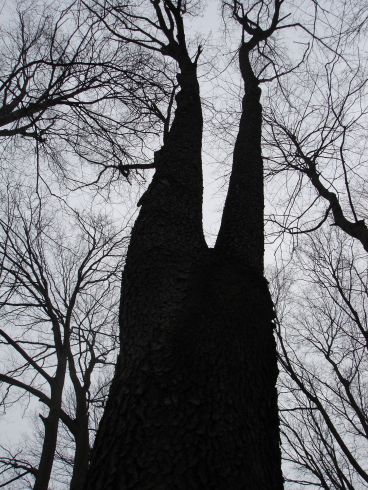
It was midafternoon and I realized that I had not yet done my daily Centering Prayer meditation. Rather than sit at my desk, as I have been doing since I started the practice two months ago, I made myself get up and walk into the woods to my special tree. My mood improves whenever I spend time with the tree, though for some reason I am always reluctant to test this proposition. I had not paid a visit to the tree for several months.

Rather than sit on the cold ground at the base of the tree I perched on the branch scar that juts from the trunk several inches off the ground. Immediately my mind became a blank slate.

I don’t know how to draw the line between excessive self-awareness, which nullifies the point of Centering Prayer, and true appreciation of the experience that this kind of meditation can bring. The prayer is an opening, an invitation, and sometimes things happen because of that opening.

Up to now the happenings have been subtle changes in my daily life and how I respond to events: an emerging sense of both purpose and contentment with the present and what comes, a deeper patience with myself and with other people. I haven’t experienced much, or expected much experience, during the meditation itself. The point is to be open, to train yourself to let go of everything the mind brings up, including expectations. The only palpable result I have noticed during the meditation has been an easy, calm, blank peace.

For a number of years, as I have written before, I have experienced this particular tree as a prayer companion, a meditation preparer, an energy field that somehow connects with me. But I had not been to the tree since starting a Centering Prayer practice. The difference this time was palpable.

What happened that afternoon at the tree was too powerful to ignore. The sense of peace was so strong that it vibrated in my core. The interval between distracting thoughts was so long it was as if the thought-manufacturing part of my mind did not exist. My earlier irritation not only dropped away; it receded so far that it seemed as if I would never feel that way again. After 20 minutes I walked back to the house elated and refreshed.

This experience was not qualitatively different from what has happened to me at the tree before. The difference was quantitative. I was far more sensitive and receptive to it than I had been before practicing Centering Prayer. The daily meditation had trained my sensibilities, opened me to this visceral experience of an unseen and indescribable reality, this tree—these trees—and my connection to them. It was as clear a before-and-after experiment as I could have engineered if I had thought about it (my tree experiences before the Centering Prayer practice and now). I didn’t think about it. I didn’t expect it. And it was therefore all the more remarkable.

And then, just as I was thinking this kind of experience was particular to the tree, something similar happened in church yesterday. I was more present, more aware, more moved by everything that unfurled in the worship service and my encounters with the community. In the beauty of a sanctuary adorned for Advent, my attention was riveted, my sensors tuned high. It was like church in HD.

A central purpose of Centering Prayer, as Cynthia Bourgeault describes it in Centering Prayer and Inner Awakening, is to learn to use “those more subtle perceptivities of spiritual awareness—the “spiritual senses,” as they’re known—to see and taste the presence of the divine as it moves fully in and out of everything.”  I think it’s working.

Congo joy, Congo lament

While we were hosting friends from Congo last week, the situation in Congo itself began deteriorating rapidly.

However, in the brief days Pastor François and his wife, Felly, spent in our home; at the Thanksgiving celebration we hosted with more friends; and in the discussions we held on how our churches might continue to relate to each other we never got around to discussing the troubles that were bringing Congo into the headlines once again after a long absence from the spotlight. The personal and communal superseded the political, even as Congo seemed on the verge of falling apart.

It was partly the timing. The invasion and conquest of Goma happened when I was too busy with the visit to be reading or listening to much news. More important, it was such a contrast to the joy and warmth of the visit itself. It coincided with a jubilant crosscultural worship service in a lovely rural Michigan church. We had other things to do and talk about and little time. This is perhaps a landmark of crosscultural friendship. We have reached a stage where the particulars of our lives, families, and aspirations; reminiscences of our shared experiences; and news of our mutual friends crowd out talk about major political/military developments with international repercussions. We don’t see or treat each other as representatives of our respective countries; we are only ourselves and we focus on each other.

This is not to say that the concerns are too distant or minor to matter to those we know and love. Our friends may return to rioting in Kinshasa, even though the events took place on the other side of that vast country, which usually seems a world apart from the capital. The Kabila government is threatened. Thus, other friends and acquaintances who are members of the Congolese parliament certainly have their hands full. And life in Congo will no doubt get more difficult before it improves (and one wonders if as well as when).

Whatever happens, it will be impossible for my husband and me, and a growing group of our friends, to ignore, because we are unalterably bound by ties of love with that impossible country. When the political is personal and the personal, political, the news can become heartrending.

I don’t know if this makes us wiser or gives us any insight about courses of action our government should take. I don’t know the truth about, say, the machinations of the Rwandan government or whether the Chinese could move in and straighten things out as some are suggesting. It is tempting to sign every e-petition that promises some kind of solution. I do let my government know I care, for what it’s worth.

What I know to do is to pray for Congo when I can pray fervently. I don’t bother much with routine prayers. My experience is that serious prayers actually make a difference. But fervent prayer comes out of love, attention, even heartbreak. My heart is breaking for Congo.