A few days ago I cleaned off my study shelves and was shocked to discover that some books had gotten moldy. I’ve never had that problem before. Our Midwestern summer has been so wet that it makes me think of Flight Behavior, Barbara Kingsolver’s devastating novel about climate change. Among the moldy books were two Bibles that had belonged to my mother, old-fashioned, tissue-leaved, King James Version, well worn. Continue reading
spirituality
Beauty and retirement
I am a glutton for natural beauty. Last week, on our way to a wedding in Pennsylvania, we made a side trip to West Virginia and I was able to feed my craving for two full days in the mountains. It made me think about how I want to live the rest of my life. Continue reading
Flower music
Yesterday I dreamed of being part of a thrilling, inventive choir that derived its music from plants. Somehow we read the plants as if they were musical notations.
This dream was no doubt inspired by Sunday’s memorial service for my friend, Karena, who passed away the day I was flying to Congo in early July. I had taken a role in caring for her during her four weeks in hospice at home and I had a role in the memorial service, as well. Continue reading
A divine setup
“I guess you just love Shirley more than me.” It was a pout, a joke, a literary reference, and a prayer, all in one.
Late at night after a gloomy, rainy-again day, a Terrible Tuesday, first day alone in a while, I was down on myself. All day I had felt like slacking off on the exercise, overeating, and reading novels. Continue reading
Lap prayers
The other day at the Y, walking my 30 laps around the track, I hit upon something that seemed too clever by half. Sometimes the juxtapositions of sacred and mundane surprise me. Continue reading
Where all the women are strong
There was a commotion outside our room yesterday morning. I opened the shutters and saw a group gathered around two travel-worn women who had set their suitcases down in the dust. Loud chatter and then a brief prayer. I went out to join the welcome party. The delegation from Bandundu North had arrived! Hugs all around.
It was the last day of the four-day Consultation of the Federation of Mennonite Women of Congo. Or, as they call themselves, more charmingly, the Fédération des Mamans Mennonites.These two Mamas had traveled to Tshikapa from Kikwit by a succession of vehicles, each of which had broken down. They ended up making their way mostly on foot. It had taken them more than a week.
A few hours later these women were in church, dressed in their finery, fresh as daisies. They sang a duet in sweet harmony and testified to the glory of God that they had gotten here at all. Never mind that the business of the meeting was all over, that they had missed the exhortations, inspirations, fellowship, and arguments. They were here, safe and sound!
Their story was not unique. Most of the 34 delegates who had gathered expended considerable effort, and money they couldn’t afford, to get there. The church has 11 ecclesiastical provinces, each allotted 5 delegates. Considering the appalling condition of most roads and the expense of flight (the round trip from Kinshasa costs $690), the fact that 34 out of 55 managed to get there was a real triumph.
One of the other delegations from Bandundu Province had simply walked. It took them a week. They weren’t complaining. They didn’t even mention it until another provincial leader, asked why she had come alone, without her allotted delegation, said there simply wasn’t enough money to bring everybody, that she had come on the back of a motorbike at her own expense. She didn’t get any sympathy, though I have heard a tough American man describe that particular motorbike trip of more than 24 hours, from Ilebo to Tshikapa, as “punishing.”
Congolese women can out-tough American men any day, and they make American women feel like pampered shrinking violets. As my friend and I slept 9 or 10 hours a night to recover from the hot days and long meetings, the Federation officers in the room next door stayed up all night praying or woke up at 4 to talk business. Self-pity is not encouraged. “Don’t think you deserve an easier life,” one woman said in a lecture in which she described the suffering and hardship that these women understood all too well. “Accept your responsibilities. Trust God to help you.”
Suck it up and trust God. It’s something we Americans could practice a bit more. On the other hand, I wondered, as the meetings dissolved frequently into loud argument, whether the toughness takes its toll in other ways. Couldn’t we have a little more kindness and gentleness? How about that namby-pamby concept of self- care?
Maybe a Congolese woman’s idea of self-care is to put on pretty clothes, sing at the top of your voice, and dance. There’s something to be said for that.
Attention!
“Les blanches! Les blanches!” The call sounded like it came far away. “Les blanches!” Urgent. I turned to see who might be calling the white women while we were sitting in church and I saw the hole in the wall next to my head, no more than 4 inches in diameter, and two pairs of bright eyes and a gap-tooth smile on the other side of it. Delight! I saw them! Continue reading
Hospice
It is a quiet day. Or is it a quiet morning? A quiet hour? Impossible to say when you are caring for the dying, which is something like caring for infants, from what I observe so far. So many pulls on your attention and there’s always the Number One, the person at the center of it all, whose immediate needs and wishes trump everything. It is impossible to plan anything, hardly even meals. Continue reading
High priest of chocolate
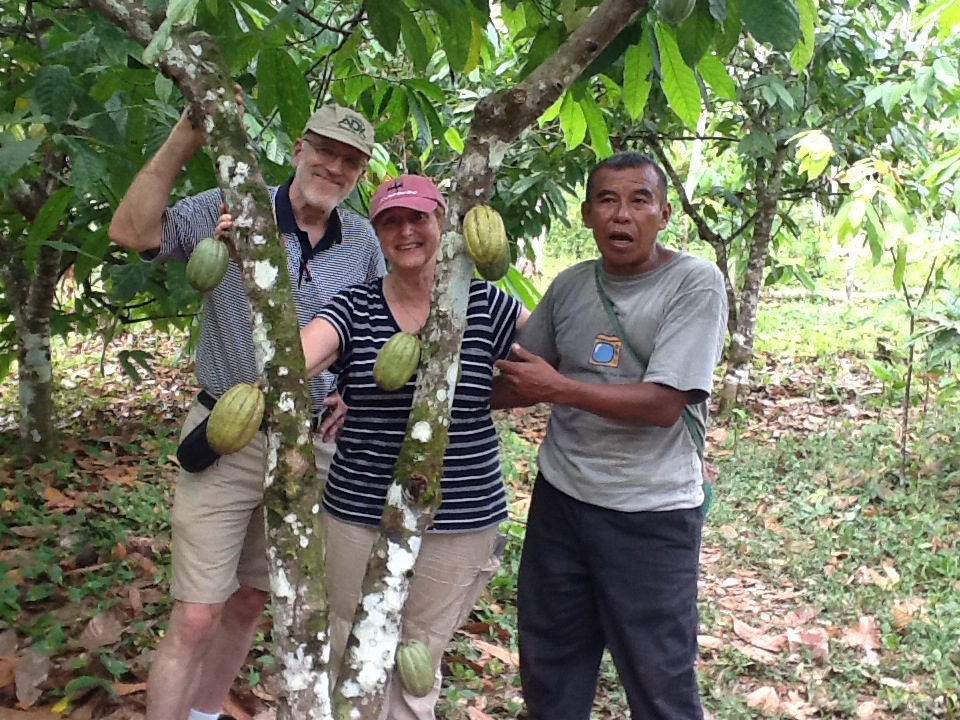
The cacao farm was not our first choice for an excursion but Ian, our host at Hickatee Cottages in Punta Gorda, Belize, brought it up a few times on the evening we arrived, as we were planning our activities for the next three days, and so I finally asked him exactly what tours he recommended. He quickly said, “The cacao farm, Blue Creek Cave, the Mayan ruins of Lubaantum, and Rio Bianco waterfall. You can do all that in two days and I’ll get you the best guide. Then you can take a day to explore Punta Gorda itself.” Continue reading
When the Bible is wrong
In light of the latest anti-Semitic atrocity, at the Kansas City Jewish Community Center, it is necessary for Christians to go beyond papal and ecumenical apologies for anti-Semitism. We must boldly proclaim that our beloved Holy Scriptures are downright wrong on some points.
Plenty of Christians, especially those who have been to seminary and studied the Bible as the writings of very real people living in very real times, know this. But rarely do you hear preachers acknowledging from the pulpit the demonstrable errancy of scripture, let alone instructing congregations in how those mistakes were made, what harm they have done, and what we should do to correct them.
It is Holy Week. Instead of devotional readings I happen to be racing through Zealot, Reza Aslan’s biography of Jesus. I was looking for entertainment reading last Sunday afternoon and came across this while browsing popular selections in my local digital library. I don’t know why I thought it would be entertaining but it actually is a good read.
The story I’m thinking of is Jesus’s alleged trial before the Roman governor, Pontius Pilate, in which Pilate finds Jesus relatively harmless and offers to set him free, following an alleged custom of releasing one prisoner for the holidays, but the Jewish crowd demands the release of another insurrectionist instead and screams for Jesus to be crucified. This is the basic story presented in the oldest gospel, Mark, but subsequent gospels embellish the story until, in John, Jesus himself is blaming the Jews and absolving Pilate.
Aslan points out, as others have done, that this scene conveniently slides the blame for Jesus’s crucifixion from the Romans to the Jews. Besides the gospel record there is no historical evidence for any of it except the fact of the execution itself.
What historical evidence there is would suggest that the story was fabricated. Historical evidence identifies Pontius Pilate as a particularly cruel tyrant who didn’t blink at executing Jewish troublemakers, which Jesus certainly was. Historical evidence identifies crucifixion as the favorite Roman method of execution for revolutionaries and bandits and guerrilla fighters, of which there were plenty at the time. Most important, historical evidence suggests that the audience for the gospel writers and the spreading Christian movement at the time these stories were written was Rome, the gentile world. So in fleshing out the whole Jesus story, 30 to 100 years after his death, the writers did not hesitate to spin the story in a way that would take the edge off of Roman responsibility. The Jews were, at that time, a lost cause, recently decisively crushed by Rome after a futile uprising and, besides, most of them didn’t accept Jesus as the Messiah, whatever one might mean by that.
“Thus, a story concocted by Mark strictly for evangelistic purposes to shift the blame for Jesus’s death away from Rome is stretched with the passage of time to the point of absurdity, becoming in the process the basis for two thousand years of Christian anti-Semitism,” Aslan writes.
Anti-Semitism is not Christian. As a Christian I don’t want to share any blame for evildoers like Frazier Glenn Cross/Miller or any of his ilk. I would like to wash my hands of him. But the anti-Semitism of today has its roots in the very beginnings of Christianity. Pretending this is not so is like turning away from clerical child abuse. Continuing to tell such harmful Bible stories to ourselves and our children is to perpetuate the conditions for abuse. Let’s set the record straight.